Read the full deal writeup
Sign up for a free Accredited account to read the editorial writeup, financials, and broker contact for this deal.
Full Editorial Writeup
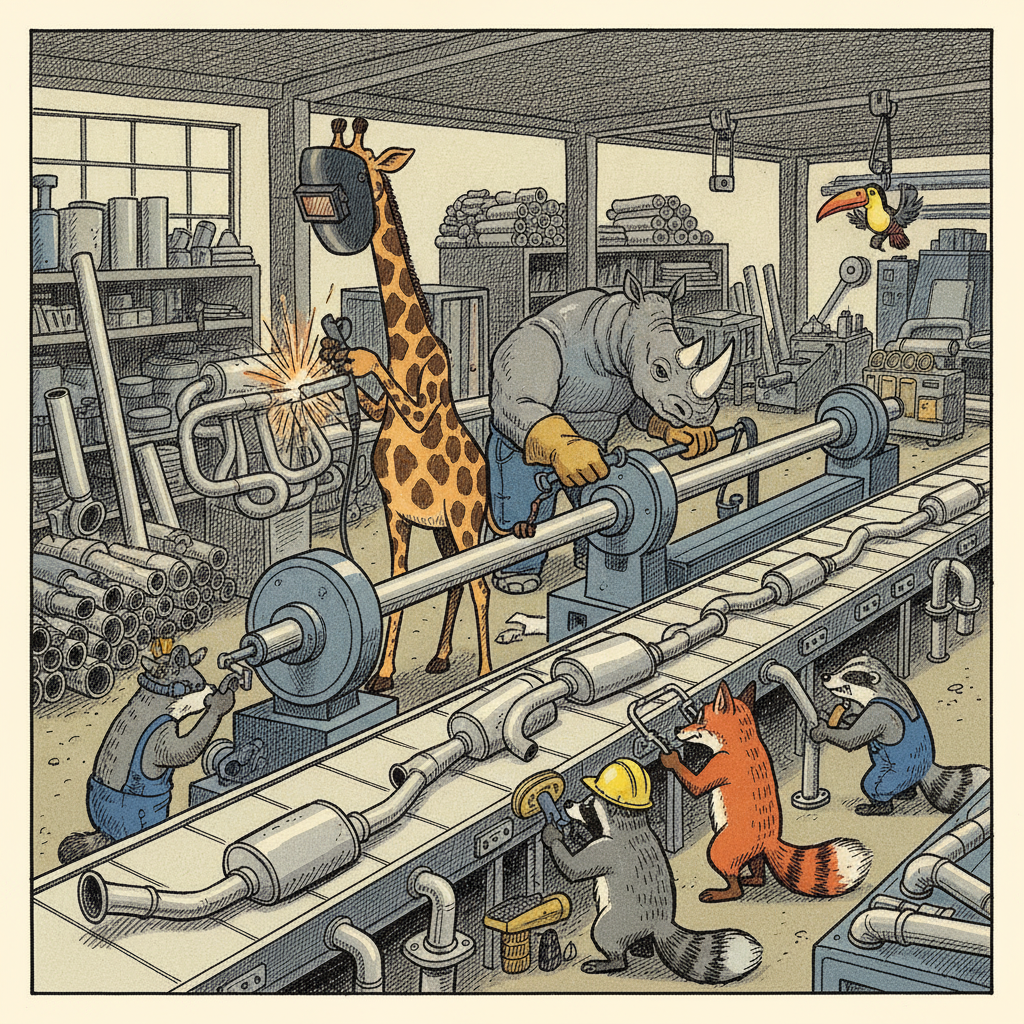
This is a 55-year-old Northern California manufacturer of exhaust components for the high-performance and hot-rod automotive aftermarket. The product line is deep and technical: mandrel bends, CNC header flanges, merge collectors, collector flanges, stainless bellows, V-band clamps, sealing flanges, and formed collectors. The business sells both B2B to exhaust fabricators and B2C to enthusiasts, with a customer base that reportedly includes NHRA and NASCAR competitors, which speaks to credibility in a market where fitment and quality matter.
The company operates out of a 22,000 square foot facility with a showroom, office, and spacious manufacturing floor, running on 9 full-time employees and an owner working only 30 hours a week. On $2M revenue it produces $525K of cash flow and $450K of adjusted EBITDA, with $575K of inventory and $1.25M of FF&E included in the $2.75M asking price. The real estate is owned by the seller but offered separately, with a NNN rent in the $17K to $19K per month range that a buyer will need to underwrite carefully.
This sits in the hot-rod and street-rod segment of the automotive aftermarket, cited at a $1.26 billion market per SEMA's Hot Rod Industry Alliance. The aftermarket picked up an estimated four million new customers during 2020, which supports near-term demand, but this remains a discretionary, enthusiast-driven category rather than an essential-needs business.
Why we like it
- Earnings quality is reasonable for a niche manufacturer: $525K cash flow and $450K adjusted EBITDA on $2M revenue implies roughly 22 to 26 percent margins, which is healthy for metal fabrication. The 55-year operating history and 32 years under current ownership suggest the numbers are real and the customer relationships are durable.
- The moat is in reputation and technical capability. Supplying NHRA and NASCAR-level fabricators means the shop has earned trust on tight-tolerance parts, and the breadth of SKUs (mandrel bends through merge collectors) makes it a one-stop source that fabricators do not casually re-shop. That stickiness protects pricing and repeat volume.
- The $1.25M of FF&E included in the deal is a real asset floor. Tooling, CNC equipment, and manufacturing fixtures of this scale would cost a buyer significantly to replicate, so a meaningful portion of the purchase price is backed by hard, productive assets rather than pure goodwill.
- The owner works only 30 hours a week with a 9-person team, which signals the business runs on established processes rather than heroics. A hands-on operator stepping in full-time has clear room to push output and sales without first having to rebuild the operation.
How to improve it
- Audit and raise prices on the slowest-turning, highest-value SKUs. In a technical niche with few credible substitutes and a loyal race-team base, modest 5 to 10 percent increases on specialty parts like merge collectors and CNC flanges likely flow almost entirely to EBITDA.
- Build a real e-commerce and digital storefront for the B2C enthusiast channel. The listing cites four million new aftermarket customers added in 2020, and a 55-year-old shop almost certainly underinvests online; capturing direct-to-enthusiast margin would diversify away from fabricator wholesale.
- Tighten inventory management against the $575K on hand. Classify SKUs by turn rate, liquidate dead stock, and free up working capital while cutting carrying cost, which directly improves cash conversion in a parts business.
- Negotiate or restructure the facility arrangement. With the seller-owned building offered separately and rent quoted at both $17,200 and $19,113, clarify the real lease, lock in a long-term rate, or seriously evaluate buying the real estate to control occupancy cost on a non-relocatable operation.
- Formalize and document key production processes and vendor relationships before the 4-week training window closes. A 32-year owner holds institutional knowledge that must be captured so the business does not depend on him post-close.
- Expand the addressable market into adjacent high-growth segments like the '60s through '80s muscle car and truck platforms the listing highlights. Developing new flange and collector fitments for those applications grows the catalog without leaving the core competency.
- Pursue consistent, documented outreach to new fabricator accounts. A niche B2B shop that has coasted on reputation likely has no systematic sales motion, so even a part-time rep or structured referral program could add incremental wholesale volume.
Diligence notes
- Reconcile the two different rent figures ($17,200 in the facilities description versus $19,113 in the real estate description) and get the actual NNN lease terms in writing. Occupancy is one of the largest fixed costs for a non-relocatable manufacturer, and the gap directly affects go-forward EBITDA.
- Scrutinize customer concentration. Trophy references like NHRA and NASCAR are great marketing, but confirm how revenue splits between B2B fabricators and B2C, and whether any single account or handful of fabricators drives an outsized share of the $2M top line.
- Verify the FF&E valuation and equipment condition. A $1.25M FF&E figure anchors much of the deal, so inspect the CNC and fabrication equipment for age, maintenance history, and any looming capex that would offset the asset value you are paying for.
- Bridge cash flow to adjusted EBITDA. The listing shows $525K cash flow but only $450K adjusted EBITDA, so understand the $75K of addbacks, confirm the owner's true workload beyond 30 stated hours, and assess what it costs to replace him.
- Test demand durability given the discretionary nature of the end market. Hot-rod and performance parts are enthusiast spending that softens in a downturn, so review revenue trends across 2020 through present to see whether the pandemic-era customer bump held or reverted.
- Confirm whether the real estate purchase is realistically optional or effectively required. The seller owns the building, it is non-relocatable, and the property is offered at additional cost, so understand the total capital outlay and financing path if you must or should acquire it.
Source
- Temperature-Controlled Trucking Company, Cold-Chain Carrier (Relocatable, CA)
- Precision Metal Component Manufacturer, 50-Year Michigan Machine Shop
- Wood Pallet Manufacturer & Pallet Management Services, 50-Year Illinois Operation
- Distinguished Powder Coating Business, 20-Year South Carolina Finisher
- Fetal Bovine Serum Manufacturer & Distributor, 25-Year Life Sciences Supplier
- Military Uniform Manufacturer, HUBZone DoD Textile Contractor
Want the full analysis on every deal? Unlock the complete platform with Accredited Pro to screen live listings and read our operator-level writeups.