Read the full deal writeup
Sign up for a free Accredited account to read the editorial writeup, financials, and broker contact for this deal.
Get Free AccessFull Editorial Writeup
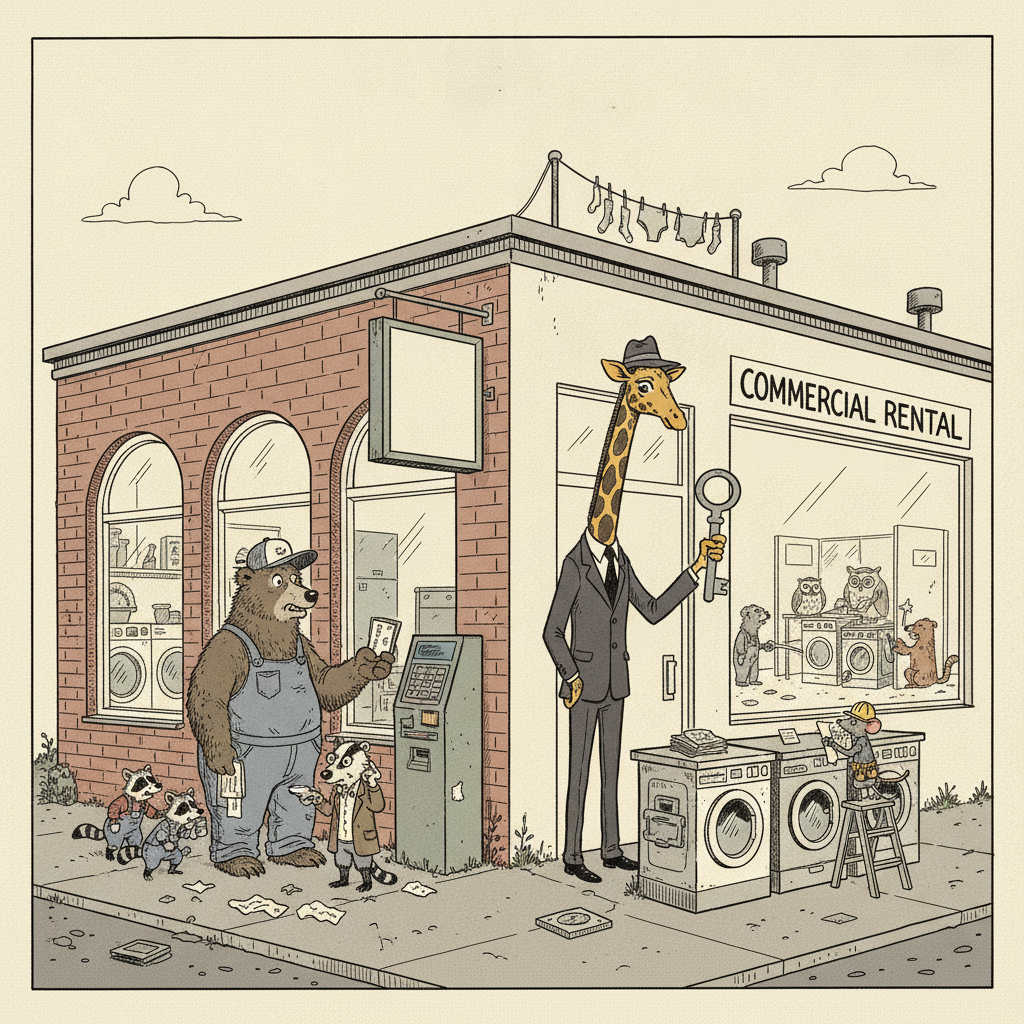
This is a combined operating business and real estate play in Essex County, New Jersey: a 25-year-old laundromat paired with a 9,000 square foot, three-tenant commercial building. The laundromat occupies 4,000 square feet with 111 Huebsch Galaxy 600 machines installed in a 2019 full renovation, a Card Concepts card payment system, 24 on-site parking spaces, and revenue from both self-service and wash-and-fold. On roughly $1.2 million in annual sales, the laundromat alone throws off about $624,224 in cash flow, with the remaining $170,816 of the blended $795,040 coming from building net operating income.
The real estate component is the quieter half of the story and arguably the more durable one. Beyond the laundromat, the building houses a martial arts studio and a dental office, giving the buyer a diversified rent roll on a signalized corner with urban and suburban foot traffic. You are acquiring both the operating cash flow and the landlord position under one ownership, which removes the classic laundromat risk of a landlord raising rent or refusing to renew.
The headline is the price. At $7.2 million against $795,040 in combined cash flow, the stated 9.06x multiple is rich for an SMB, but that number blends operating SDE with real estate NOI, so the real question is how the price splits between the business and the dirt. Capitalizing the $170,816 NOI at a market rate values the real estate in the low seven figures, which reframes the operating business multiple materially once you back out the building.
Why we like it
- Laundromats are about as recession-resistant as retail services get: people wash clothes in every economy, and a card-based, partially unattended model keeps labor low. The 2019 renovation with 111 newer Huebsch machines means the heavy capex cycle is behind you and the equipment should run years before major replacement.
- Owning the building eliminates the single biggest existential risk in the laundromat business, which is lease renewal and rent escalation at the hands of a third-party landlord. You control the real estate, the signalized corner location, and the 24 parking spaces outright, so nobody can squeeze your margins at renewal.
- The rent roll is genuinely diversified and sticky, with a dental office and a martial arts studio alongside the laundromat producing $170,816 in NOI. A dental tenant in particular is a high-credit, long-stay occupant, and that income is independent of how the laundromat performs.
- Revenue is inherently repeat-driven: self-service wash cycles and wash-and-fold customers return weekly, and commercial tenants pay rent on contracts by default. This is route-like, habitual cash flow rather than a business that has to re-win every sale, which supports the valuation floor.
How to improve it
- Split the deal economically and underwrite the operating business and the real estate separately. Capitalize the $170,816 NOI at a market cap rate to value the dirt, back that out of the $7.2 million, and renegotiate on the residual operating multiple, which is the single highest-leverage move before signing.
- Add and promote commercial laundry and wash-and-fold contracts with local restaurants, salons, gyms, and Airbnb operators. These B2B accounts drive high-margin volume into existing machines during off-peak daytime hours and convert walk-in demand into contracted recurring revenue.
- Install a mobile app and digital loyalty layer on top of the Card Concepts system to capture customer data, push promotions, and enable remote top-ups. Modern laundromat apps lift average spend and give you pricing-test visibility you do not get from a pure card system.
- Review the in-place rents on the dental and martial arts tenants against current market and bring any below-market leases up at renewal. Even a modest NOI increase compounds directly into real estate value at the cap rate and improves refinance proceeds.
- Audit utility costs, which are the largest variable expense in any laundromat, and evaluate high-efficiency dryer retrofits, water reclamation, and a solar or demand-management arrangement. Shaving utility spend drops straight to the $624,224 operating cash flow line.
- Add ancillary revenue inside the existing footprint: vending, detergent and sundries sales, bill pay, ATM placement, and amazon or dry-cleaning drop-off. These require minimal space and capital and raise revenue per square foot on rent you already pay yourself.
Diligence notes
- Separate the laundromat P&L from the building financials line by line. The listing blends $624,224 of operating cash flow with $170,816 of building NOI, and you need audited or bank-verified figures for each, because the quality and the multiple are completely different between an operating business and a leased asset.
- Verify the laundromat revenue through card-system reporting, not just a representation. Card Concepts generates transaction-level data, so pull 24 to 36 months of raw collection and settlement records to confirm the $1.2 million in sales and the mix between self-service and wash-and-fold.
- Review the two commercial leases in full: term remaining, renewal options, rent escalations, and tenant credit. The dental and martial arts leases underpin the $170,816 NOI, and a near-term expiration or a weak tenant materially changes the real estate value.
- Independently appraise the real estate and obtain a market cap rate for comparable mixed-use corner retail in Essex County. This determines how much of the $7.2 million is dirt versus operating goodwill and whether the blended 9.06x is actually reasonable or inflated.
- Confirm the condition and remaining life of the 111 Huebsch machines installed in 2019, plus the HVAC, boiler, water heaters, and roof on a 25-year-old building. Deferred capex on utilities infrastructure can be substantial and should be priced into your offer.
Source
- NY Commercial Cleaning & Maintenance Co., 50-Year New York Facilities Contractor
- Organic Dry Cleaner, Absentee-Run Hudson County NJ Plant
- High Volume Dry Cleaner, Nassau County NY
- Restaurant Deep Cleaning Service - Cleveland
- Restaurant Sanitation Company - Atlanta
- Boise Cleaning & Restoration - Dual Revenue Model
Want the full analysis on every deal? Unlock the complete platform with Accredited Pro to screen live listings and read our operator-level writeups.