The SBA Just Reported $39.5 Billion in Small Business Lending. Here's Where the Money Went.
TL;DR: On November 2, 2026, the SBA said it delivered $100 billion in capital and related assistance in fiscal year 2026. The lending piece of that is $39.5 billion across 62,205 loans guaranteed through the 7(a) and 504 programs: $32.4 billion through 56,130 7(a) loans and $7.1 billion through 6,075 504 loans. That is down 11.8% in dollars and 26.3% in loan count from the FY2025 record of $44.8 billion and 84,400 loans, but still up 4.5% from FY2024 and the third-highest lending year on record. A 43-day government shutdown froze new approvals for the first six weeks of the year and, by the SBA's estimate, kept about $5 billion from going out. The bigger story for buyers is the shape of the drop: the number of 7(a) loans fell 28% while the average 7(a) loan rose 21% to about $577,000. Fewer, larger loans, and business acquisitions took a bigger share of the dollars than they did a year earlier.
What did the SBA announce for FY2026?
The SBA closed its fiscal year on September 30, 2026 and published the results today. The agency's headline is $100 billion in "capital and related assistance," the second straight year it has cleared that mark.
Here is how the release breaks down:
| Program or segment | FY2026 dollars | FY2026 loans or units |
|---|---|---|
| 7(a) and 504 combined | $39.5B | 62,205 loans |
| 7(a) | $32.4B | 56,130 loans |
| 504 | $7.1B | 6,075 loans |
| Startups (7(a) and 504) | $6.5B | 9,700+ loans |
| Rural businesses (7(a) and 504) | $6.5B | 10,314 loans |
| Construction and manufacturing (7(a) and 504) | $7.0B | 11,790 loans |
| SBIC program | $60B portfolio | 46 new licenses |
| Disaster loans approved | $272M | 5,879 loans |
| Entrepreneurial development | $419M obligated | Resource partner network |
The agency said accommodation, retail trade, health care, construction, and manufacturing were the strongest lending sectors. It also called out smaller programs: 149 loans for nearly $300 million under the 90% Made in America guarantee, 79 loans for $145 million under the 90% grocery guarantee, and 59 MARC revolving credit loans for $54 million.
How is the $100 billion actually calculated?
Worth reading the math before quoting the headline. The $100 billion is not $100 billion of new loans made this year.
About $39.5 billion is 7(a) and 504 lending approved during FY2026. Most of the rest is the Small Business Investment Company program, which the SBA says closed the year with a record $60 billion in combined private capital and SBA leverage. That is a portfolio figure, the size of the program at year end, not money deployed in twelve months. Disaster lending and entrepreneurial development add under $1 billion together.
That also explains how the total held at $100 billion two years running while lending fell. In FY2025, the SBA reported $44.8 billion in 7(a) and 504 lending and a $53 billion SBIC portfolio. In FY2026, lending dropped about $5.3 billion and the SBIC portfolio grew about $7 billion. The two moves roughly cancel out.
None of this makes the number wrong. It just means that if you finance acquisitions with SBA debt, the $39.5 billion is your number, not the $100 billion.
How does FY2026 SBA lending compare to previous years?
Down from the record, above everything before it except the record years.
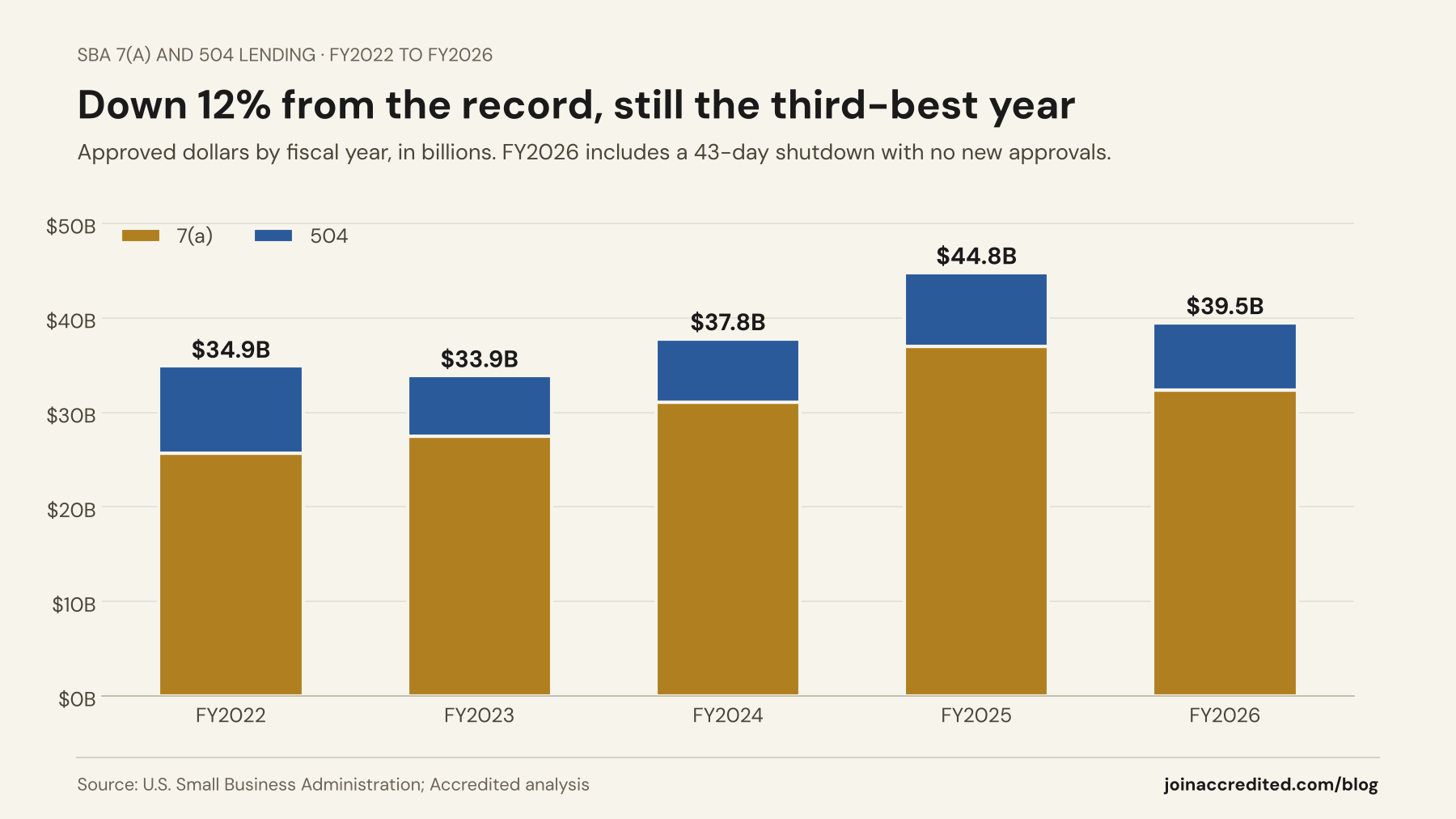
| Fiscal year | 7(a) loans | 7(a) dollars | 504 loans | 504 dollars | Combined dollars |
|---|---|---|---|---|---|
| FY2022 | 47,678 | $25.7B | 9,254 | $9.2B | $34.9B |
| FY2023 | 57,362 | $27.5B | 5,924 | $6.4B | $33.9B |
| FY2024 | 70,242 | $31.1B | n/a | $6.7B | $37.8B |
| FY2025 | 77,600 | $37.0B | 6,750 | $7.8B | $44.8B |
| FY2026 | 56,130 | $32.4B | 6,075 | $7.1B | $39.5B |
FY2022 through FY2024 figures are SBA year-end approvals as compiled by LendingTree. FY2025 and FY2026 are from the SBA's year-end releases. FY2025 counts were later revised slightly upward in SBA loan-level data (78,078 7(a) loans, $37.3 billion), so treat small differences as rounding.
The year-over-year moves:
| Change | FY2026 vs FY2025 | FY2026 vs FY2024 |
|---|---|---|
| Combined 7(a) and 504 dollars | -11.8% | +4.5% |
| Combined loan count | -26.3% | n/a |
| 7(a) dollars | -12.4% | +4.2% |
| 7(a) loan count | -27.7% | -20.1% |
| 504 dollars | -9.0% | +6.0% |
| 504 loan count | -10.0% | n/a |
So the honest framing: FY2026 was a down year against an unusually strong FY2025, and a modestly up year against the trend line. The SBA's own release calls it the third-highest lending volume in agency history. The two years above it are the FY2025 record and FY2021, when pandemic stimulus temporarily raised SBA guarantees to 90%.
How much did the government shutdown cost SBA borrowers?
The fiscal year opened with a 43-day federal shutdown, from October 1 to mid-November 2025. The 7(a) and 504 programs stopped approving new loans for the duration. The SBA estimates it could not guarantee about $170 million in loans per business day, roughly $5 billion over the period.
Add that $5 billion back and FY2026 lands at about $44.5 billion, within shouting distance of the record.
There is a second distortion that cuts the other way. Lenders saw the shutdown coming and rushed approvals into September 2025. Lumos Data's analysis puts September 2025 7(a) approvals at $4.6 billion, about 56% above a normal September, implying roughly $1.7 billion was pulled forward into FY2025. That inflated last year's record and deflated this year's comparison.
But the shutdown does not explain everything. Six frozen weeks is about 12% of the year. Loan count fell 28%. Something else was going on.
Why did the number of SBA loans drop so much more than the dollars?
Because the credit box got smaller, and the small loans fell out of it first.
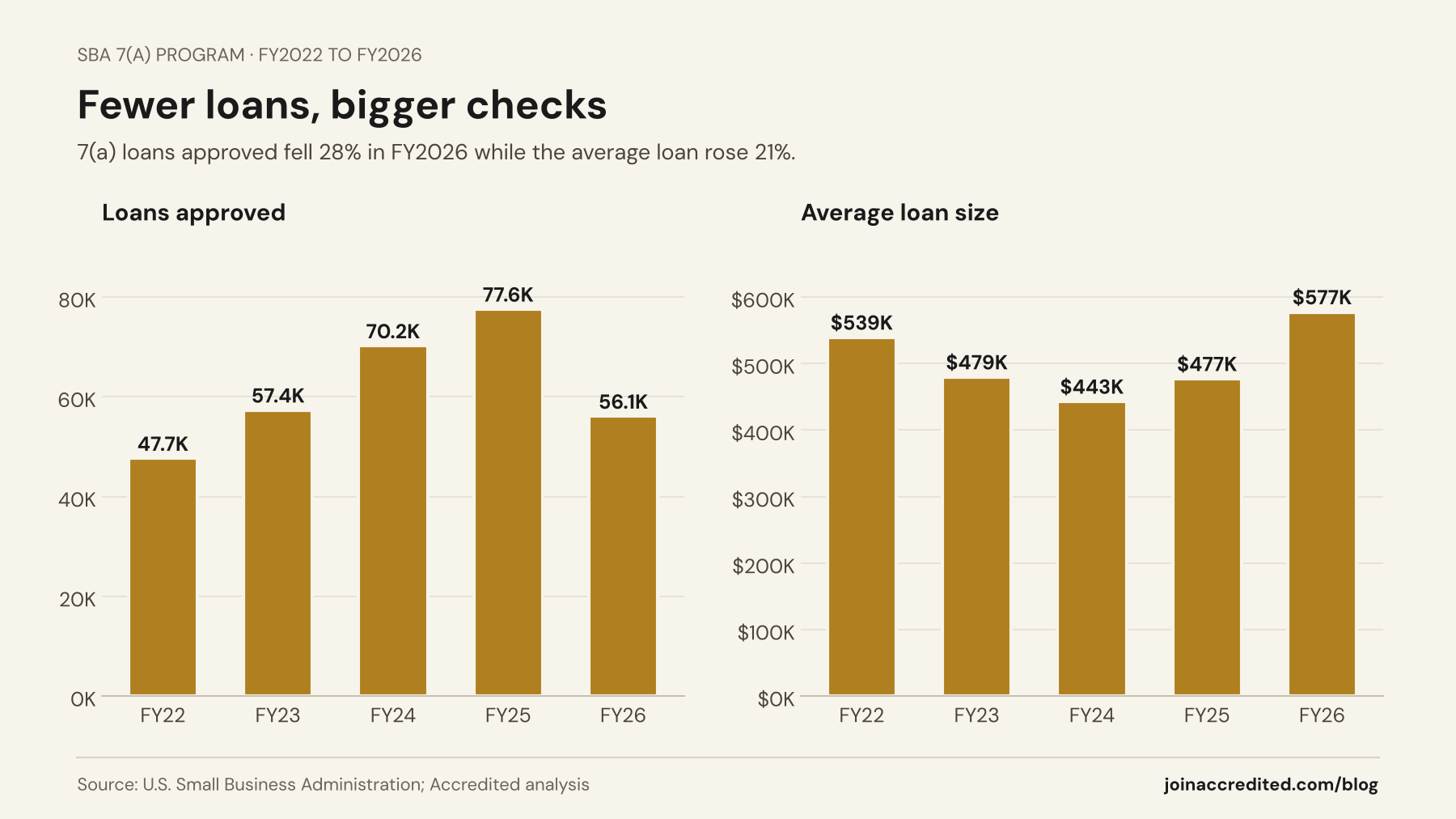
From FY2022 to FY2024 the 7(a) program got busier and smaller: more loans, lower average size, driven by streamlined underwriting for loans under $150,000. FY2026 reversed that. The average 7(a) loan rose from about $477,000 to about $577,000, the highest in at least five years.
Three policy changes stacked on top of the shutdown:
SOP 50 10 8 (June 2025). Reinstated the 10% equity injection for startups and changes of ownership and tightened small-dollar loan rules. Its effects ran through the full FY2026 year.
The citizenship rule (March 1, 2026). Every direct and indirect owner of an SBA borrower must now be a U.S. citizen or national with a principal residence in the U.S. Green card holders are excluded at any ownership percentage. This came after a January change that briefly allowed up to 5% foreign ownership, so lenders spent the first half of the year rewriting checklists.
Fewer lenders. Lumos Data counted 1,141 participating 7(a) lenders through the first nine months of FY2026, down 18.9% year over year and a 30-year low.
The loan-size data shows where it bit. Through June, Lumos found 7(a) loans of $500,000 or less down about 38% by count versus about 15% for loans above $500,000. Every one of 20 industry sectors declined by count. When underwriting tightens, the marginal small loan is the first thing to go. The larger, better-documented deals still closed.
How much SBA lending goes to buying businesses?
More than the headline suggests, and the share is rising.
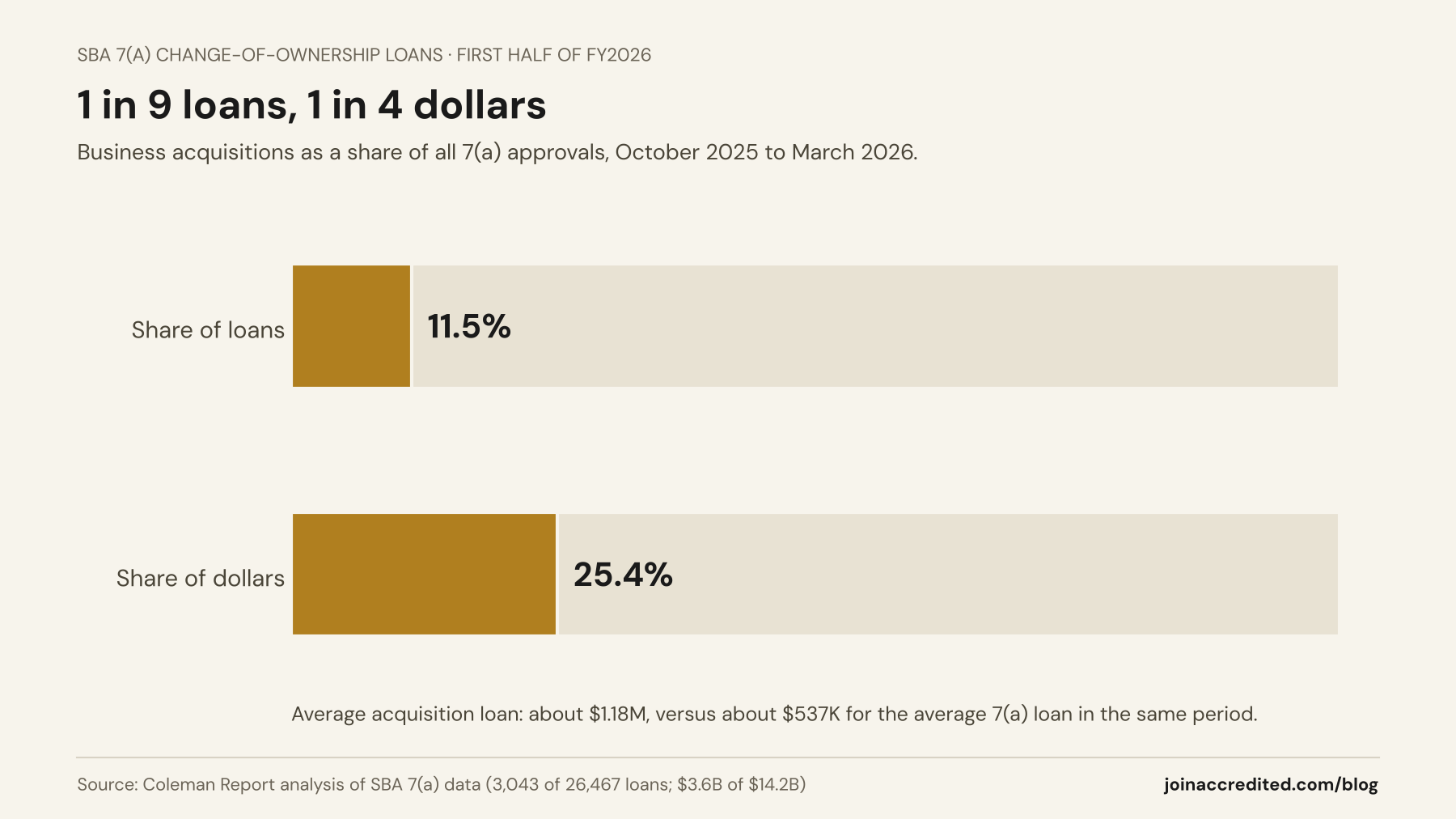
The SBA release does not break out change-of-ownership lending. The Coleman Report's analysis of SBA loan data for the first six months of FY2026 found 3,043 acquisition loans out of 26,467 total 7(a) approvals. That is 11.5% of loans but $3.6 billion of $14.2 billion in dollars, or 25.4%.
For context, Coleman put FY2025 acquisition lending at more than $9 billion, or 23.6% of 7(a) dollars. A separate iBusiness Funding analysis counted about $8.29 billion across roughly 7,003 acquisition deals that year.
The average acquisition loan in the first half of FY2026 worked out to about $1.18 million, more than double the roughly $537,000 average for all 7(a) loans in the same period.
If acquisitions held their first-half share for the full year, FY2026 change-of-ownership lending would come in around $8.2 billion. That is our estimate, not an SBA figure. Full-year data will settle it.
Either way, the takeaway for ETA is the same. While total 7(a) volume shrank, SBA-backed acquisition financing held its ground and grew as a share of the program. One in four 7(a) dollars now buys an existing business.
Where did the rest of the money go?
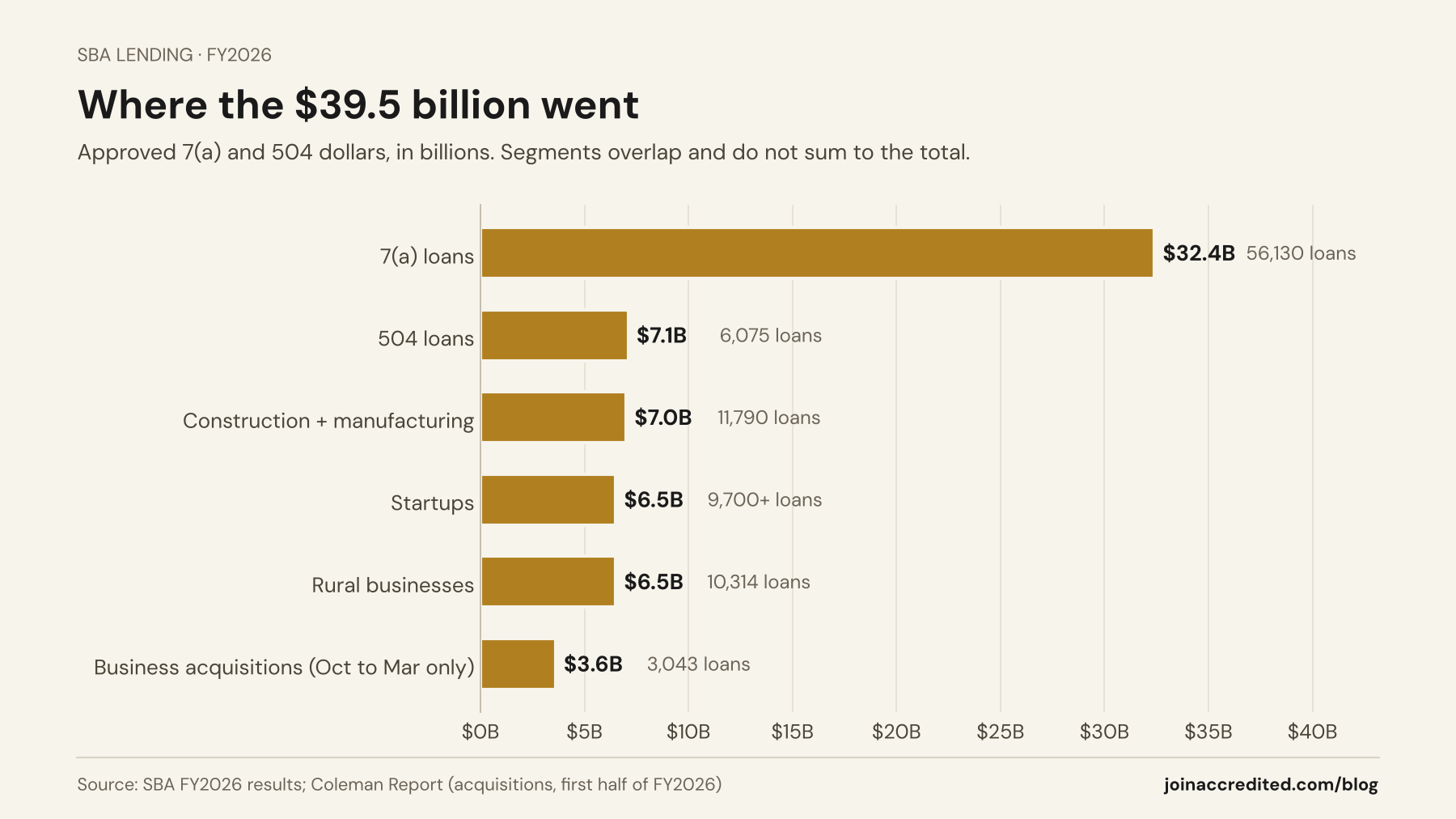
Read each segment as a slice of the same $39.5 billion, not as an additive bucket.
| Segment | FY2026 dollars | Loans | Average loan |
|---|---|---|---|
| Construction and manufacturing | $7.0B | 11,790 | ~$594K |
| Startups | $6.5B | 9,700+ | ~$670K |
| Rural businesses | $6.5B | 10,314 | ~$630K |
| 504 (all) | $7.1B | 6,075 | ~$1.17M |
| Change of ownership, first half only | $3.6B | 3,043 | ~$1.18M |
Construction and manufacturing is the segment the SBA has pushed hardest this year, with fee waivers for manufacturers and the 90% Made in America guarantee. Startups at $6.5 billion is notable given that startups and changes of ownership both got the stricter 10% equity rule in 2025.
What does this mean if you are buying a business with an SBA loan?
Four practical reads.
The money is still there. $32.4 billion in 7(a) lending in a year that lost six weeks to a shutdown is a large, functioning market. Acquisition loans are a growing share of it. If your deal fits the box, it gets financed.
The box is narrower than it was a year ago. Citizenship, equity injection, and lender appetite all tightened before October 1. Then SOP 50 10 8.1 took effect for FY2027, raising the coverage floor to 1.25x for first-time buyers, ending projection-based underwriting, and removing 7(a) Small underwriting for every change of ownership. FY2027 starts with a tighter rulebook than any month of FY2026.
Bigger deals have the easier path. The data says lenders kept writing larger, well-documented loans while small loans collapsed. A $1.5 million acquisition with clean financials and a lender that does a lot of change-of-ownership work is in a better position than a $300,000 deal with a messy add-back schedule.
Pick your lender for acquisitions, not convenience. With participating lenders at a 30-year low, the remaining ones are more concentrated and more specialized. Ask any lender how many change-of-ownership loans they closed in FY2026 before you send them a file.
If you are earlier in the process, our guide to how to finance a business acquisition covers the full capital stack, including seller notes and investor equity under the new rules.
Find deals that fit the new SBA box
Lenders now underwrite to trailing cash flow and nothing else. Every deal we publish leads with the actual numbers: revenue, SDE or EBITDA, asking multiple, and what the earnings look like before anyone starts adding things back.
Accredited searches 54,000+ US businesses for sale from 7,500+ brokerages, deduplicated, and sends one fully analyzed deal each weekday. Browse today's deals or create a free account to get one vetted deal a day. Accredited Pro adds off-market owner discovery, where most of our best buyers find businesses before a broker prices them.
For more on the market, see our monthly business-for-sale market report, our analysis of the Silver Tsunami, and our guide on how to find off-market businesses.
Frequently asked questions
How much did the SBA lend in fiscal year 2026?
The SBA guaranteed 62,205 loans worth $39.5 billion through its 7(a) and 504 programs in FY2026, which ran from October 1, 2025 to September 30, 2026. That includes $32.4 billion across 56,130 7(a) loans and $7.1 billion across 6,075 504 loans.
Did SBA lending go up or down in 2026?
Down from FY2025 and up from FY2024. Combined 7(a) and 504 dollars fell 11.8% from the FY2025 record of $44.8 billion and loan count fell 26.3% from 84,400. Against FY2024's $37.8 billion, FY2026 was up 4.5%. The SBA calls it the third-highest lending year on record.
What is the SBA's $100 billion figure made of?
About $39.5 billion is 7(a) and 504 lending approved in FY2026. Most of the remainder is the SBIC program, which the SBA says ended the year with a $60 billion portfolio of combined private capital and SBA leverage. Disaster loans ($272 million approved) and entrepreneurial development ($419 million obligated) make up the rest.
How did the 2025 government shutdown affect SBA loans?
The 43-day shutdown that began October 1, 2025 halted new 7(a) and 504 approvals. The SBA estimates it blocked about $170 million in guaranteed loans per business day, roughly $5 billion in total. Lenders also pulled about $1.7 billion of approvals into September 2025 ahead of the shutdown, which inflated FY2025 and made the FY2026 comparison look worse.
Why did the average SBA 7(a) loan size increase in 2026?
Small loans fell much faster than large ones. Through June 2026, 7(a) loans of $500,000 or less were down about 38% by count, versus about 15% for loans above $500,000. Tighter eligibility, including the March 2026 citizenship rule and the 2025 equity injection requirement, plus fewer participating lenders, squeezed out smaller borrowers first. The average 7(a) loan rose from about $477,000 in FY2025 to about $577,000 in FY2026.
How much SBA 7(a) lending goes to business acquisitions?
About a quarter of the dollars. In the first half of FY2026, change-of-ownership loans were 3,043 of 26,467 7(a) approvals (11.5%) but $3.6 billion of $14.2 billion (25.4%), per the Coleman Report. In FY2025, acquisition lending was more than $9 billion, or 23.6% of 7(a) dollars.
Are SBA loans harder to get for business buyers in FY2027?
Yes, for most first-time buyers. SOP 50 10 8.1 took effect October 1, 2026 and applies to loans that get an SBA loan number on or after that date. It raises the debt service coverage floor to 1.25x for initial acquisitions, bars lenders from using projections to meet it, caps total debt at the appraised business value, and requires a lender-ordered Quality of Earnings report for business purchase prices of $3 million or more.
Sources
- SBA Fuels Main Street Growth with $100 Billion Delivered in FY26, SBA news release 26-113 (November 2, 2026)
- Trump SBA Delivers Record Capital to Small Businesses in FY25, SBA news release 25-83 (September 30, 2025)
- SBA's SBIC Program Delivers Record Capital in FY25, SBA via GlobeNewswire (November 19, 2025)
- SBA loan approvals by fiscal year and loan type, LendingTree analysis of SBA data
- SBA 7(a) Program Performance in FY2026: What the Data Actually Shows, Lumos Data
- One in Four SBA 7(a) Lending Dollars Finances Business Acquisitions, Coleman Report
- SBA Business Acquisition Lending in 2026, Coleman Report
- SBA 7(a) and 504 Financing Statistics 2026, CT Acquisitions (iBusiness Funding acquisition figures)
- Small Business Administration shuts out non-U.S. citizens from its main lending program, CBS News
Disclaimer
This article is for informational and educational purposes only. It is not legal, tax, financial, or investment advice, and it is not a commitment to lend. Figures are taken from SBA releases and third-party analyses of SBA data as of November 2, 2026 and may be revised. Estimates labeled as ours are Accredited calculations, not SBA figures. SBA policy is subject to change and individual lenders apply their own credit standards on top of the SOP. Verify current requirements at sba.gov and consult your lender, attorney, and CPA before making any acquisition or financing decision. Accredited is a publisher, not a broker-dealer, investment adviser, lender, or licensed M&A intermediary.