How to Finance a Business Acquisition: SBA, Seller Notes, Banks, and Investors (2026)

TL;DR:
- Most small business acquisitions under $5 million are financed with an SBA 7(a) loan, a seller note, and 10% buyer equity. Everything else is a variation on that stack.
- Under SOP 50 10 8.1 (effective Oct 1, 2026), the SBA requires a 10% equity injection on a first-time acquisition, measured on total project cost, and 1.25x debt service coverage on historical earnings. Projections no longer count.
- A seller note counts toward that 10% only if it is on full standby for the life of the SBA loan (no principal, no interest, usually 10 years). Standby seller debt, other standby debt, and passive investor equity together can cover at most half of the injection.
- A seller note that is not part of the injection can be paid from day one, as long as the business still clears 1.25x coverage with those payments included. Interest-only notes are underwritten as if they amortize over 10 years.
- Total debt, including any seller note not on full standby, is capped at the appraised business value. Earnouts are still prohibited in SBA deals.
- Conventional bank debt, asset-based loans, mezzanine, and investor equity fill the gaps: deals over $5 million, deals that fail SBA coverage, or buyers who want to avoid an unlimited personal guarantee.
- Plan on closing with working capital equal to one normal operating cycle, plus a personal cash reserve. As a rule of thumb for most service businesses, that means 2 to 3 months of operating expenses inside the company.
What are the ways to finance a business acquisition?
There are nine common sources, and most deals use two to four of them. The table compares them on the terms buyers actually negotiate. Rates and terms for non-SBA products are typical market ranges as of October 2026, not rules, and they vary by lender.
| Option | Typical size | Term | Typical cost | Buyer equity needed | Personal guarantee | Best for | Main catch |
|---|---|---|---|---|---|---|---|
| SBA 7(a) loan | Up to $5M | 10 yrs (business), up to 25 yrs on real estate portion | Prime + up to 3% cap on loans over $350K, plus 2% to 3.75% upfront guaranty fee | 10% of total project cost (first acquisition) | Unlimited, every 20%+ owner | First acquisitions of $500K to $5M with clean tax returns | 1.25x historical coverage, full standby rules on seller equity, no earnouts |
| Seller note (standby, counts as equity) | Up to 5% of project cost | Life of SBA loan, then repays | Interest accrues, usually 5% to 8% | Replaces up to half the 10% | Usually none to seller | Closing the cash gap on an SBA deal | Seller gets nothing for about 10 years |
| Seller note (paying, not equity) | 10% to 30% of price | 3 to 10 yrs | 5% to 8% | None directly | Sometimes | Bridging valuation gaps, sharing risk with the seller | Payments count against your 1.25x coverage |
| Conventional bank term loan | $1M and up | 3 to 7 yrs | Prime + 1% to 3% or SOFR spread | 20% to 30% | Often limited or none above a size | Larger deals, strong buyers, repeat acquirers | Shorter amortization, 2x to 3x EBITDA leverage cap |
| SBA 504 loan | Real estate and heavy equipment, up to $5M per project (CDC portion) | 10, 20, or 25 yrs | Fixed rate on CDC portion, 0.5% upfront fee | Usually 10% | Yes | Buying the building or major equipment with the business | Can't fund goodwill or working capital |
| Asset-based loan / equipment financing | 50% to 85% of receivables, 50% of inventory, 70% to 100% of equipment | Revolver or 3 to 7 yrs | Prime + 2% to 6% | Varies | Usually | Distribution, manufacturing, staffing | Borrowing base audits, covenants |
| Mezzanine / subordinated debt | $2M and up | 5 to 7 yrs, interest-only | 12% to 18%, often with warrants | Sits between bank debt and equity | Sometimes | Lower-middle-market deals above SBA limits | Expensive, rarely available below $1M EBITDA |
| Investor equity (Reg D) | Any size | Until exit | 20% to 30% target returns, preferred return, carry | Is the equity | No | Searchers without cash, larger stacks | Securities law, dilution, SBA caps passive equity |
| Rollover equity / ROBS | 5% to 20% (rollover); retirement balance (ROBS) | Until exit | Seller keeps upside (rollover); tax and plan risk (ROBS) | Counts as equity | Seller who keeps any stake guarantees SBA loan for 2 yrs | Aligning the seller; funding injection from a 401(k) | Seller guarantee rules; ROBS is an IRS audit focus |
The rest of this guide covers the rules for each one, then shows how they combine into real capital stacks.
What are the SBA 7(a) rules for buying a business in 2026?
An SBA 7(a) acquisition loan tops out at $5 million, requires 10% equity on a first acquisition, and must clear 1.25x coverage on historical earnings. Those rules come from SOP 50 10 8.1, which applies to loans that receive an SBA loan number on or after October 1, 2026. For the full rundown, see our breakdown of the new SBA acquisition rules.
Which transaction type is your deal?
Appendix 15 sorts every change of ownership into four types. Your type sets your coverage floor and equity requirement.
| Transaction type | Who it covers | Minimum DSCR | Equity injection | QoE at $3M+ purchase price |
|---|---|---|---|---|
| Initial Acquisition (default) | First-time buyer of this business | 1.25x | 10% of total project cost, cannot be reduced | Required |
| Business Expansion | Existing business, 2+ full fiscal years, buying another in the same 4-digit NAICS group | 1.15x | 10%, can be reduced or waived | Required |
| Owner Buyout | Ownership change inside the existing business | 1.25x | 10% of purchase price, can be reduced or waived | Exempt |
| ESOP or Cooperative | Employee or co-op purchase of 51%+ | 1.25x | Exempt | Exempt |
At the October 20, 2026 SBA Connect Call, the agency clarified that someone who has not been an employee for 24 months cannot become the largest shareholder in an Owner Buyout. Fail that test and the deal is underwritten as an Initial Acquisition.
The rules that shape every SBA acquisition
- Loan size and guaranty. Maximum loan is $5 million. SBA guarantees 75% on loans over $150,000, capped at $3.75 million of exposure.
- Rate cap. Variable-rate loans over $350,000 are capped at the base rate plus 3%. Smaller loans allow wider spreads.
- Upfront guaranty fee (FY2027, loans approved Oct 1, 2026 to Sept 30, 2027). 2% of the guaranteed portion on loans of $150,000 or less, 3% from $150,001 to $700,000, and 3.5% above $700,000, plus an extra 0.25% on any guaranteed amount over $1 million. Manufacturers, certain food supply chain businesses, and rural businesses pay 0% on loans of $700,000 or less. The fee can be financed into the loan.
- Equity injection. 10% of total project cost on an Initial Acquisition. Project cost includes the purchase price, working capital, closing costs, and the guaranty fee, not just the price.
- What counts as equity. Unlimited sources: your own unborrowed cash, nonborrowed cash gifts, and personal loans repaid from outside the business. Limited sources, capped together at 50% of the required injection: seller notes on full standby, other standby debt, and equity from passive investors who own under 20% with no control. Money spent on the valuation and QoE counts as prepaid equity. Education, advisory, and buyer-paid agent fees do not.
- Coverage. 1.25x on the last fiscal year or a two-year average, using historical or adjusted earnings. Projections cannot be used to meet the floor. Every add-back needs written justification.
- Debt cap. Total transaction debt, including any seller note not on full standby, cannot exceed the appraised business value. Paying above appraisal means cash or a full-standby seller note.
- Term. The business portion amortizes over a maximum of 10 years, no balloon. Real estate can run up to 25 years, blended on a weighted average. Special-purpose owner-occupied real estate making up 85%+ of project cost can get 25 years.
- Quality of Earnings. Required on Initial Acquisitions and Business Expansions with a business purchase price of $3 million or more. The SBA now accepts a buyer-obtained QoE if the lender's selected QoE vendor reviews it. Seller-prepared reports are still prohibited.
- Personal guarantees. Every owner of 20% or more guarantees the full loan. A seller who keeps any equity in a partial sale guarantees for two years and can be released after 24 months if the loan has been current for the prior 12.
- Seller transition. The seller can stay on as a consultant for up to 24 months in aggregate, not as an employee or officer.
- Structure. Partial changes of ownership must be stock or membership interest purchases. Earnouts are prohibited. Buyer rebates tied to post-close performance are allowed if they pay down principal.
- Ownership. Since March 1, 2026, borrowers must be 100% owned by U.S. citizens or U.S. nationals with a U.S. principal residence. Lawful permanent residents no longer qualify. This rule has changed several times in 2026, so confirm the current notice with your lender.
- Small deals. 7(a) Small and SBA Express loans can finance a change of ownership, but only under the full Appendix 15 credit standards. There is no scorecard shortcut for acquisitions.
How much seller financing can you use with an SBA loan?
There is no fixed SBA cap on total seller financing. There are two separate seller notes, each with its own rules. The first can stand in for up to 5% of project cost as equity, but the seller gets nothing until the SBA loan is gone. The second can be much larger and can pay the seller from month one, but every dollar of payments has to fit inside 1.25x coverage and the total debt cap.
| Equity seller note (full standby) | Paying seller note (not equity) | |
|---|---|---|
| Counts toward the 10% injection? | Yes | No |
| Maximum size | Half the required injection (5% of project cost on a 10% injection), shared with any other standby debt and passive investor equity | No SBA percentage cap. Limited by coverage and by the rule that total debt cannot exceed appraised value |
| When the seller gets paid | Nothing, principal or interest, until the SBA loan is repaid in full. Usually 10 years | Can start at closing if the deal clears coverage with the payments included |
| Effect on DSCR | None. No payments, so no debt service | Fully counted. Interest-only notes are underwritten as if they amortize over 10 years |
| Effect on the debt cap | Sits outside the cap | Counts against the cap |
| Paperwork | SBA Form 155 standby agreement, lien subordinated, no collection action without lender consent | Subordination agreement on lender terms, often Form 155 with payment terms |
| Can it be refinanced? | Only after it comes off standby | Must be in place and current for 36 months before it can be refinanced (up from 24) |
When can the seller start getting paid?
It depends entirely on which note the money sits in.
- Equity note on full standby: after the SBA loan is paid off, typically year 10. Some lenders allow the note to accrue interest during standby, then amortize over the following years. If the buyer refinances or pays off the SBA loan early, the standby ends then.
- Paying note: as early as the first month after closing, on whatever schedule the buyer, seller, and lender agree, as long as the business clears 1.25x historical coverage with the note's payments included.
- Lender-imposed delay: many lenders require a paying note to sit on partial or full standby for the first 12 to 24 months anyway, as a credit condition. That delay does not make it count as equity. Since SOP 50 10 8 took effect in June 2025, only life-of-loan full standby does.

What changed, and what didn't
- Gone: the 24-month standby seller note that counted as equity. That rule ended with SOP 50 10 7.1 in June 2025. A lot of broker content still repeats it.
- Gone: interest-only seller notes that flattered year-one coverage. Lenders now impute a 10-year amortization.
- New in 8.1: passive investor equity now shares the same 50% bucket as the standby seller note. If an investor covers half your injection, there is no room left for a standby note to count.
- Unchanged: the 10% minimum, the 50% cap on standby seller equity, and the ban on earnouts.
How to structure seller financing in practice
- Match amortization to the bank. A seller note that repays faster than the SBA loan eats coverage and makes the lender nervous. Ten-year terms with modest payments are easier to approve than five.
- Use both layers. A common structure is a 5% standby equity note plus a 5% to 15% paying note. The seller gets current income on the second and a back-ended payout on the first.
- Price the standby note for the wait. A seller who waits 10 years with no payments is taking real risk. Expect a higher rate on that note, or a larger total price.
- Remember the tax angle. Sellers often prefer receiving part of the price over time because installment sale treatment can spread capital gains across years. Have the seller confirm with their CPA.
- No earnouts in SBA deals. If you and the seller disagree on value, bridge it with a larger paying note or a price reduction, not a contingent payment.
When should you use conventional bank debt or other loans instead of SBA?
Use non-SBA debt when the deal is too big for SBA, fails SBA coverage, or when you would rather put in more equity to avoid an unlimited personal guarantee. Each option below has its own rules.
Conventional bank term loans
- What it looks like: a 3 to 7 year term loan from a bank or credit union, sized to roughly 2x to 3x EBITDA of senior debt, with 20% to 30% buyer equity.
- Why use it: no SBA guaranty fee, no SBA eligibility rules, no citizenship requirement, more flexibility on earnouts and seller terms, and guarantees can be limited or dropped as the deal grows.
- Watch out for: shorter amortization means higher annual payments on the same loan. Banks also impose financial covenants (minimum DSCR, maximum leverage) tested quarterly, and a missed covenant gives the bank leverage over you.
- Who gets it: buyers with industry experience, a track record, or an existing platform, buying businesses with $1M+ of EBITDA.
SBA 504 loans
- What it funds: owner-occupied real estate and long-life equipment, not goodwill or working capital. In an acquisition, it finances the building or heavy equipment while a 7(a) or bank loan funds the business itself.
- Typical structure: 50% bank first lien, 40% Certified Development Company second lien, 10% borrower equity. The CDC portion runs up to $5 million ($5.5 million for manufacturers and certain energy projects) on 10, 20, or 25-year fixed terms.
- Cost: FY2027 fees are a 0.5% upfront guaranty fee and a 0.203% annual service fee on the CDC portion, plus CDC processing and funding fees.
- Combining programs: under current guidance, 504 and 7(a) exposure are counted separately, so a borrower may be able to hold up to $5 million in each. Confirm with your lender.
Asset-based loans and equipment financing
- What it looks like: a revolving line secured by receivables and inventory, or a term loan secured by equipment. Advance rates commonly run 70% to 85% of eligible receivables and 25% to 50% of inventory.
- Why use it: it lets trading-heavy businesses (distribution, staffing, manufacturing) borrow against the assets that actually turn over. SOP 50 10 8.1 now explicitly allows pairing a 7(a) acquisition loan with a working capital line that takes first lien on receivables and inventory.
- Watch out for: borrowing base certificates, field exams, and lockbox arrangements. Availability shrinks exactly when sales slow.
Mezzanine and subordinated debt
- What it looks like: a 5 to 7 year interest-only note behind the senior lender, priced at roughly 12% to 18%, often with warrants or an equity kicker.
- Who uses it: lower-middle-market buyers and search funds stretching leverage above what a bank will lend alone. Most mezz funds want $2M+ of EBITDA.
- Watch out for: it is rarely compatible with SBA loans, since non-standby debt counts toward coverage and the debt cap.
Revenue-based financing and merchant cash advances
- Our view: avoid using them to fund a purchase price. Effective annual costs routinely exceed 30%, payments come out daily or weekly, and SBA lenders treat existing advances as debt that hurts coverage. They have a narrow place in short-term working capital for an already-owned business, not in an acquisition stack.
How do you raise investor capital to buy a business?
Selling equity or notes to investors is a securities offering, so you need an exemption from SEC registration before you take a dollar. Almost every acquisition raise uses Regulation D Rule 506(b) or 506(c). Then, if an SBA loan is in the stack, the SBA's own equity rules decide how much of that money counts toward your down payment.
Which securities exemption fits?
| Exemption | Max raise per 12 months | Who can invest | Can you advertise? | Filing | Fits acquisitions when |
|---|---|---|---|---|---|
| Rule 506(b) | Unlimited | Unlimited accredited investors plus up to 35 non-accredited but sophisticated investors | No. Investors must come from pre-existing relationships | Form D within 15 days of first sale | You are raising from people you already know |
| Rule 506(c) | Unlimited | Accredited investors only, and you must take reasonable steps to verify status | Yes | Form D | You want to market the deal publicly, including in newsletters and on social |
| Regulation Crowdfunding | $5 million | Anyone, with per-investor limits for non-accredited | Yes, through a registered funding portal | Form C, financial statements | Consumer-facing businesses with customers who want to own a piece |
| Regulation A Tier 2 | $75 million | Anyone, non-accredited capped at 10% of income or net worth | Yes | Form 1-A, SEC qualification, ongoing reporting | Rarely for small acquisitions. Too slow and expensive |
| Rule 504 | $10 million | Anyone | Limited | Form D plus state registration | Rarely used |
An accredited investor is generally someone with $200,000 of individual income ($300,000 joint) in each of the last two years, or $1 million of net worth excluding their primary residence, or certain securities licenses. Verify the current SEC definition before you rely on it.
Two compliance traps catch first-time sponsors. Paying anyone a percentage of capital raised can make them an unregistered broker-dealer, so pay finders and advertisers a flat fee or nothing. And the moment you post about a live raise publicly, you are in 506(c) territory, which means verifying every investor.
How the SBA treats investor money
- Passive investors are a limited source. Under SOP 50 10 8.1, equity from investors who each own less than 20% with no control counts toward at most half of the required injection, and that half is shared with any standby seller note.
- Distribution lockup. When passive investor money is used to meet the required injection, those investors can receive only tax distributions until the SBA loan is repaid. A cash preferred return on that capital is off the table.
- The workaround. Cover at least half the injection with your own cash, then raise investor capital above the required minimum. That excess capital is not subject to the lockup, subject to your lender's agreements.
- The 20% line. Any investor at 20% or more must personally guarantee the full loan. Most passive investors will not, so cap tables are built to keep each investor below 20%.
- Trusts. If any owner holds shares through a trust, the trust and the trustor must guarantee the loan at any ownership percentage. Ask investors how they will hold shares before you paper the round.
Other equity sources
- Traditional search fund. Investors fund a searcher's salary and expenses for 18 to 24 months, then get the right to fund the acquisition. Search capital typically converts at a 1.5x step-up. Deals are usually financed with conventional or mezz debt rather than SBA.
- Self-funded search. The searcher pays their own search costs and raises equity deal by deal, usually alongside SBA debt. More ownership for the searcher, more personal risk.
- Independent sponsor. You find and negotiate the deal, then raise equity for that one deal and earn a closing fee, management fee, and carried interest.
- Rollover equity. The seller keeps 5% to 20% of the business. It aligns the seller with the outcome, but under SBA rules a seller who keeps any stake must guarantee the loan for two years.
- ROBS (Rollover as Business Startup). You roll a 401(k) or IRA into a new company retirement plan that buys stock in your C-corp, then use that cash as equity. It avoids early withdrawal penalties and many SBA lenders accept it as a cash source, but it requires a C-corporation and ongoing plan compliance, and it is a known IRS audit focus. Use a specialist provider and a CPA, and ask your lender how it treats ROBS funds.
Looking for investors? Accredited's newsletter reaches accredited investors who read deal analysis five days a week. Advertise a 506(c) raise.
What does a typical acquisition capital stack look like?
Four structures cover most small business deals. The numbers below are illustrative, built at a 10.5% SBA rate, 10-year amortization, and the FY2027 guaranty fee. EBITDA is after paying the owner a market salary, which is how lenders measure it.
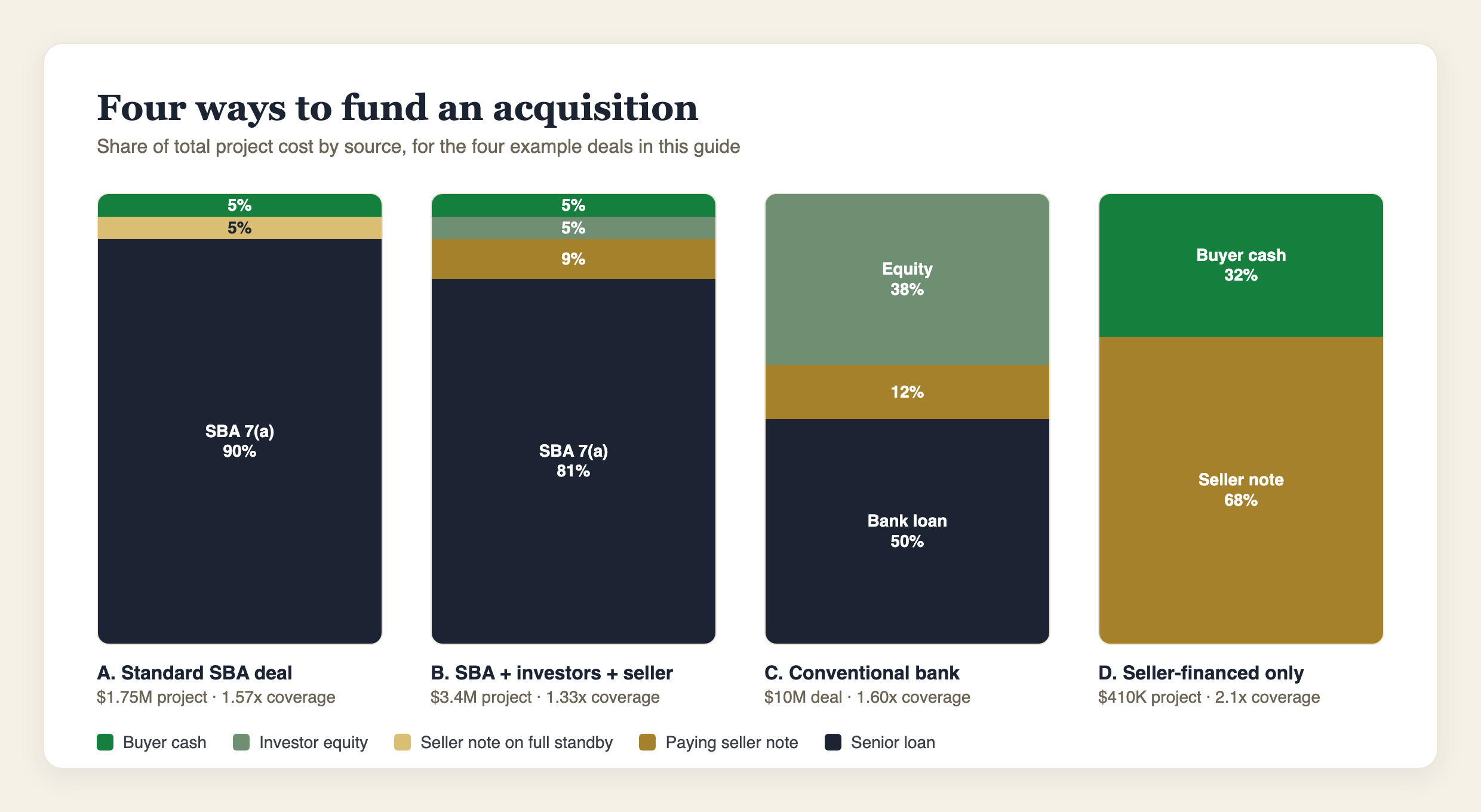
| A. Standard SBA deal | B. SBA + investors + paying seller note | C. Conventional bank, larger deal | D. Seller-financed only | |
|---|---|---|---|---|
| Business | Home services company | B2B services company | Specialty manufacturer | Small route or service business |
| Purchase price | $1,500,000 | $3,000,000 | $10,000,000 | $400,000 |
| EBITDA | $400,000 | $650,000 | $2,000,000 | $140,000 |
| Multiple | 3.75x | 4.6x | 5.0x | 2.9x |
| Working capital funded at close | $175,000 | $250,000 | From ABL revolver | From buyer cash |
| Closing costs and fees | $75,000 | $150,000 | Paid from equity | $10,000 |
| Total project cost | $1,750,000 | $3,400,000 | $10,000,000+ | $410,000 |
| Buyer cash | $87,500 (5%) | $170,000 (5%) | $3,800,000 (38%), mostly investor equity | $130,000 (32%) |
| Passive investor equity | None | $170,000 (5%, fills the limited bucket) | Included above | None |
| Seller note on full standby (equity) | $87,500 (5%) | None, bucket already full | Not applicable | Not applicable |
| Paying seller note | None | $300,000, 7%, 10 yrs | $1,200,000, 7%, 5 yrs | $280,000, 7%, 5 yrs |
| Senior loan | SBA 7(a) $1,575,000 | SBA 7(a) $2,760,000 | Bank term loan $5,000,000, 9%, 7 yrs | None |
| Annual debt service | $255,000 | $488,700 | $1,250,000 | $66,500 |
| Coverage | 1.57x | 1.33x | 1.60x | 2.1x |
| Seller paid starting | Year 11 on the standby note | Month 1 on the paying note | Month 1 | Month 1 |
What each example teaches
- A. Standard SBA deal. The cleanest first acquisition. The buyer brings 5% in cash, the seller's standby note covers the other 5%, and the business clears 1.25x with room to spare. The SBA guaranty fee alone is about $41,800, which is why closing costs matter in the project cost.
- B. SBA + investors + paying seller note. The investors and the standby note now compete for the same half of the injection, so only one of them can count. The seller gets paid from month one on a separate note, and the deal still clears at 1.33x. Watch the debt cap: total debt here is $3.06 million, so this only works if the appraisal comes in at or above that number. At a $3.0 million appraisal the buyer needs roughly $60,000 more cash or a larger full-standby note. Ask your lender how it measures the cap when working capital and fees are financed. The $3 million price also triggers a QoE.
- C. Conventional bank, larger deal. Above the SBA's $5 million limit, the stack shifts to 2.5x senior leverage, a seller note, and 35% to 40% equity. Coverage is healthy, but the 7-year amortization makes payments heavy. Earnouts are allowed here because there is no SBA loan.
- D. Seller-financed only. Small deals where the seller carries most of the price and no bank is involved. Fastest to close and the most flexible, but the seller usually keeps a lien on the business and assets until paid, and a default can hand the business back.
Bonus: the second acquisition
Once you have owned a business for two full fiscal years, buying another in the same 4-digit NAICS industry group qualifies as a Business Expansion under SOP 50 10 8.1. Coverage drops to 1.15x, and the lender can reduce or eliminate the 10% injection if the existing company has enough post-close liquidity. The catch: if the equity requirement is reduced or waived, the loan cannot include permanent working capital, and no other 7(a) loan can add it within 90 days.
How much working capital should you keep after buying a business?
Enough to fund one full operating cycle on day one, plus a cushion. In an asset purchase the seller usually keeps the cash and the receivables, so the business you take over has an empty bank account and bills due in 30 days. Running out of working capital in the first 90 days is one of the most common ways a sound acquisition goes sideways.
Step 1: calculate the operating cycle need
Working capital need = receivables to build + inventory − payables
- Receivables to build = annual revenue ÷ 365 × days sales outstanding (DSO).
- Inventory = what you must stock to keep selling.
- Payables = what suppliers let you defer.
Example A from above: $2.4 million of revenue with a 25-day DSO means about $164,000 of receivables to build. Add $30,000 of inventory, subtract $50,000 of payables, and the cycle need is about $144,000.
Step 2: add a cushion
| Business type | Rule-of-thumb cushion on top of the cycle need | Why |
|---|---|---|
| Recurring service, monthly billing | 1 to 2 months of operating expenses | Predictable cash, low inventory |
| Project-based or B2B on net-30 to net-60 | 2 to 3 months of operating expenses | Slow-paying customers and lumpy jobs |
| Seasonal (landscaping, pool, HVAC) | Fund the trough: cash to cover the slowest 3 to 4 months | Revenue and payroll don't line up |
| Inventory-heavy (distribution, retail, manufacturing) | Cycle need plus an asset-based revolver | Growth eats cash faster than profit replaces it |
These are operator rules of thumb, not SBA or lender requirements.
For Example A, $175,000 funded at close plus a $100,000 undrawn line of credit covers the cycle need and roughly a month of expenses.
Step 3: decide how to fund it
- Inside the SBA loan. Permanent working capital can be financed in the 7(a) and sits in total project cost, so the 10% injection applies to it too. Financing it is usually cheaper than draining your personal cash. Exception: on a Business Expansion or Owner Buyout where the lender reduces the injection, permanent working capital is off the table.
- A separate line of credit. A revolver (an SBA CAPLine or a bank line) handles seasonal swings without paying term-loan interest on cash you don't use. SOP 50 10 8.1 now explicitly allows pairing one with the acquisition loan.
- A working capital peg in the purchase agreement. In a stock purchase, or an asset deal where receivables transfer, set a normalized working capital target. If the business delivers less at close, the price drops dollar for dollar. Brokers often skip this on smaller deals. Ask for it.
Step 4: keep a personal reserve
Lenders run a global cash flow test on your personal finances, and they look at post-close liquidity. Separately from the business's working capital, keep at least 6 months of personal living expenses outside the deal. That is a common lender expectation, not an SBA rule. An owner who has to pull extra salary in month three is starving the business at the worst possible time.
Find a deal the financing actually works on
The new SBA rules made historical cash flow the only number that counts. Every deal we publish leads with revenue, SDE or EBITDA, and the multiple, so you can run the coverage math before you call the broker. Browse today's deals, or use Accredited Pro to search 52,000+ businesses for sale across 12 marketplaces and find off-market owners who have never talked to a broker.
Frequently Asked Questions
How much down payment do you need to buy a business with an SBA loan?
10% of total project cost on a first-time acquisition, under SOP 50 10 8.1. At least half must come from unlimited sources such as your own cash. The other half can come from a full-standby seller note or passive investors. On a $1 million project, that is $100,000 of equity with at least $50,000 in cash.
How much seller financing can you use with an SBA loan?
A full-standby seller note can cover up to half the required injection, or 5% of project cost. A separate paying seller note has no SBA percentage cap, but its payments must fit inside 1.25x coverage and total debt cannot exceed the appraised value.
When can the seller start getting paid on an SBA seller note?
A note counted as equity pays nothing until the SBA loan is repaid, usually 10 years. A note not counted as equity can pay from the first month after closing if the business still clears 1.25x coverage with those payments included.
Does a 24-month standby seller note still count toward the SBA down payment?
No. That rule ended in June 2025 with SOP 50 10 8. A seller note now counts as equity only on full standby for the life of the SBA loan.
Can you use an earnout in an SBA acquisition?
No. Earnouts are prohibited in SBA 7(a) acquisitions because the price must be fixed at closing. Buyer rebates tied to post-close performance are allowed if they pay down loan principal.
What debt service coverage ratio does the SBA require to buy a business?
1.25x for Initial Acquisitions, Owner Buyouts, and ESOPs, and 1.15x for Business Expansions. It is measured on the last fiscal year or a two-year average of historical earnings. Projections cannot be used to meet it.
How much working capital should you have after buying a business?
Enough to fund one operating cycle (receivables plus inventory minus payables) plus a cushion of 1 to 3 months of operating expenses, depending on the business. Keep a separate personal reserve of at least 6 months of living expenses.
Can investors fund my down payment on an SBA loan?
Partly. Passive investors owning under 20% count toward at most half of the required injection, shared with any standby seller note. When their money is used for the injection, they can receive only tax distributions until the SBA loan is repaid.
Sources
- New SBA Rules for Business Acquisitions Take Effect October 1, 2026, Accredited, Aug 20, 2026
- SBA Information Notice 5000-880695, Issuance of SOP 50 10 8.1, Aug 14, 2026
- SBA Information Notice 5000-881797, FY 2027 7(a) Program Fees, effective Oct 1, 2026
- SBA Information Notice 5000-881796, FY 2027 504 Program Fees, effective Oct 1, 2026
- SBA Hot Topic Tuesday: SBA Clarifies Acquisition Rules, Coleman Report, Oct 27, 2026 (Oct 20 SBA Connect Call)
- Procedural Notice 5000-876626, Revised Ownership, Citizenship, and Residency Requirements, effective Mar 1, 2026
- Investor Equity Under SOP 50 10 8.1, Pioneer Capital Advisory
- Exempt Offerings Chart, U.S. Securities and Exchange Commission
Disclaimer
This article is for informational and educational purposes only. It is not legal, tax, financial, or investment advice, and it is not an offer to sell or a solicitation of an offer to buy any security. SBA and SEC rules change, and lenders apply their own standards on top of them. Verify current requirements at sba.gov and sec.gov and consult your lender, attorney, and CPA before making any acquisition or financing decision. Accredited is a media and research platform, not a broker-dealer, investment adviser, lender, or licensed M&A intermediary.