Read the full deal writeup
Sign up for a free Accredited account to read the editorial writeup, financials, and broker contact for this deal.
Get Free AccessFull Editorial Writeup
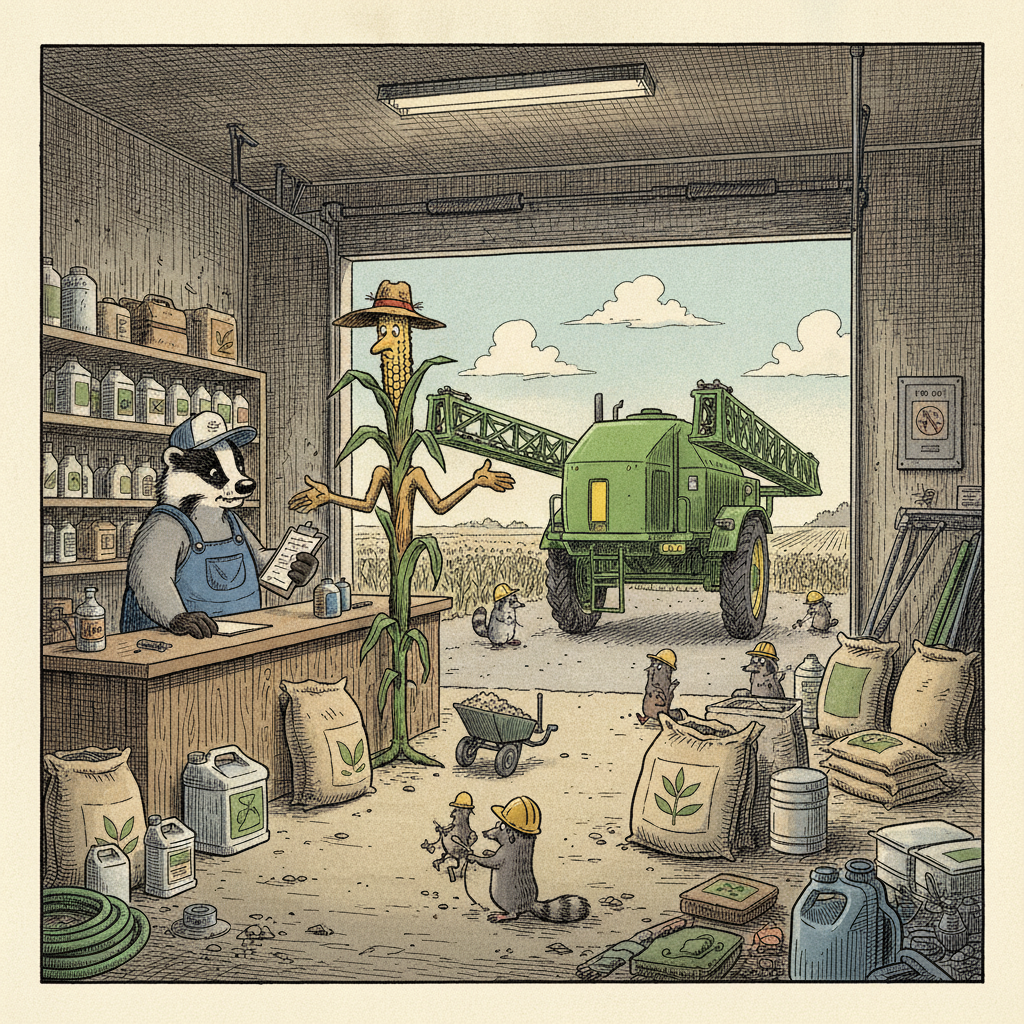
This is a licensed agricultural input retailer and custom application business founded in 2011, serving farmers and ranchers across a roughly 100-mile radius spanning Oklahoma, Texas, and Kansas from a base in Arnett, Oklahoma. The company sells crop protection chemicals (about 40% of revenue), fertilizer (about 40%), and seed, then applies those inputs by ground with two owned sprayer rigs and by air. It also provides crop, land, and wildlife consulting, giving it a recommend-supply-apply model that captures both the input margin and the application fee on the same acre.
The structural appeal here is the stickiness: about 80% of the business is chemical and fertilizer, both of which growers consume and repurchase every single crop year. The business holds all three required Oklahoma licenses (Certified Applicator, Fertilizer, and Chemical), which function as a genuine barrier to entry in a rural trade area where licensed custom application is supply-constrained and consolidation has thinned independent local providers. The licensed applicator on staff is willing to stay under new ownership, which de-risks the single most important operational dependency.
Operations are lean to the point of being almost spartan: two salaried non-union employees, a single 1,600 sq ft leased facility at $2,000 a month, outsourced accounting, and net-30 customer terms. 2025 results were $2.52M revenue, $995K gross profit at a 39.5% margin, $706K SDE, and $606K adjusted EBITDA. Remarkably, the business has never advertised in fifteen years, meaning every customer came through reputation and referral, which leaves marketing, rig utilization, and outer-radius expansion as clearly untapped growth levers.
Why we like it
- Earnings quality is strong for a sub-$3M deal: $706K SDE on $2.52M revenue is a 28% owner-earnings margin, with a 39.5% gross margin and genuinely lean overhead (two employees, $2,000 monthly rent, outsourced books). The model double-dips on each acre by earning both the input margin and the application fee, which is why those economics hold.
- The moat is real and rare for a business this size. Three required Oklahoma licenses plus owned sprayer equipment create a hard barrier to entry, and in narrow in-season application windows the company can serve growers when unequipped competitors cannot. Rural consolidation has thinned local independents, so remaining operators get pricing and relationship leverage.
- Revenue is structurally recurring even though the listing never uses the word. Roughly 80% of the business is chemical and fertilizer that growers must consume and repurchase every crop year, and the recommend-supply-apply bundle is exactly why farmers consolidate with one provider rather than splitting the order.
- The operator upside is unusually clean because the business has literally never advertised. Fifteen years of pure reputation and referral means a buyer who adds a website, local search, in-season radio, and a referral program is pulling levers that have never been touched, with supplier co-op dollars potentially offsetting the spend.
How to improve it
- Stand up basic demand generation immediately: a website, Google Business Profile, and local search presence in the first 90 days. For a business that has never advertised, even minimal digital visibility should surface growers in the outer radius who have never heard of the company.
- Push rig utilization. With two owned sprayers running well under capacity (1,200 and 1,800 hours) plus air application, the fixed equipment can serve more acres at near-zero incremental cost. Build a scheduling system to maximize billable application during the narrow in-season windows that are the company's edge.
- Launch in-season radio and farm-print advertising timed to planting and spray windows, and apply for supplier co-op marketing dollars from the national crop protection and seed brands already in the relationship. This can effectively subsidize customer acquisition that currently costs nothing but also produces nothing.
- Formalize the consulting line. Crop, land, and wildlife consulting is mentioned as a service but appears informal and under-monetized. Packaging it as a paid advisory retainer would add a higher-margin recurring layer and deepen switching costs on each grower relationship.
- Lock down the licensed applicator and cross-train redundancy. The staff applicator is the critical dependency; secure a retention agreement and begin sponsoring a second person through licensing so the business is not one person away from losing its ability to operate.
- Evaluate buying the facility. The landlord is open to selling at $2,000/month rent, which is cheap enough that owning the property could be accretive and would remove lease risk on the only operating location. Run the math on an SBA 7(a) real estate add-on.
- Expand the geographic radius deliberately. The current 100-mile footprint across three states was built passively; mapping underserved counties and targeting them with direct outreach and localized ads converts an accidental territory into an intentional growth plan.
Diligence notes
- Verify customer concentration and the referral base. A business built entirely on reputation over 15 years may have a handful of large grower relationships driving most revenue, and with net-30 terms you need the aging report plus a top-10 customer breakdown to size concentration and collection risk.
- Scrutinize the 2025 figures against prior years. Only one year of results is quoted ($2.52M revenue, $706K SDE), and ag input businesses swing with commodity prices, crop acreage, weather, and input cost cycles. Pull three to five years of returns to confirm the earnings are a trend, not a single strong harvest.
- Confirm license transferability and the applicator retention. The entire moat rests on three Oklahoma licenses and one licensed staff applicator who is merely 'willing to stay.' Get a signed retention commitment and verify whether the licenses transfer with the entity or require the new owner to re-qualify.
- Assess the $800K equipment at true market value. Equipment is included in the price and inflates the multiple versus a pure-services comp, so inspect the New Holland sprayers, the 1999 Peterbilt tender, and the tank fleet for condition, deferred maintenance, and realistic remaining life before accepting the FMV figure.
- Clarify the add-backs behind SDE versus the $606K adjusted EBITDA. The $100K gap between SDE and EBITDA plus any owner adjustments need itemization to confirm the true normalized earnings a passive-ish or absentee buyer would actually inherit, especially given how lean the two-person staff is.
- Understand supplier terms and exclusivity. Margins depend on relationships with national crop protection and seed brands; confirm whether pricing, rebates, or co-op dollars are tied to the current owner personally and whether those terms survive a change of control.
Source
Want the full analysis on every deal? Unlock the complete platform with Accredited Pro to screen live listings and read our operator-level writeups.