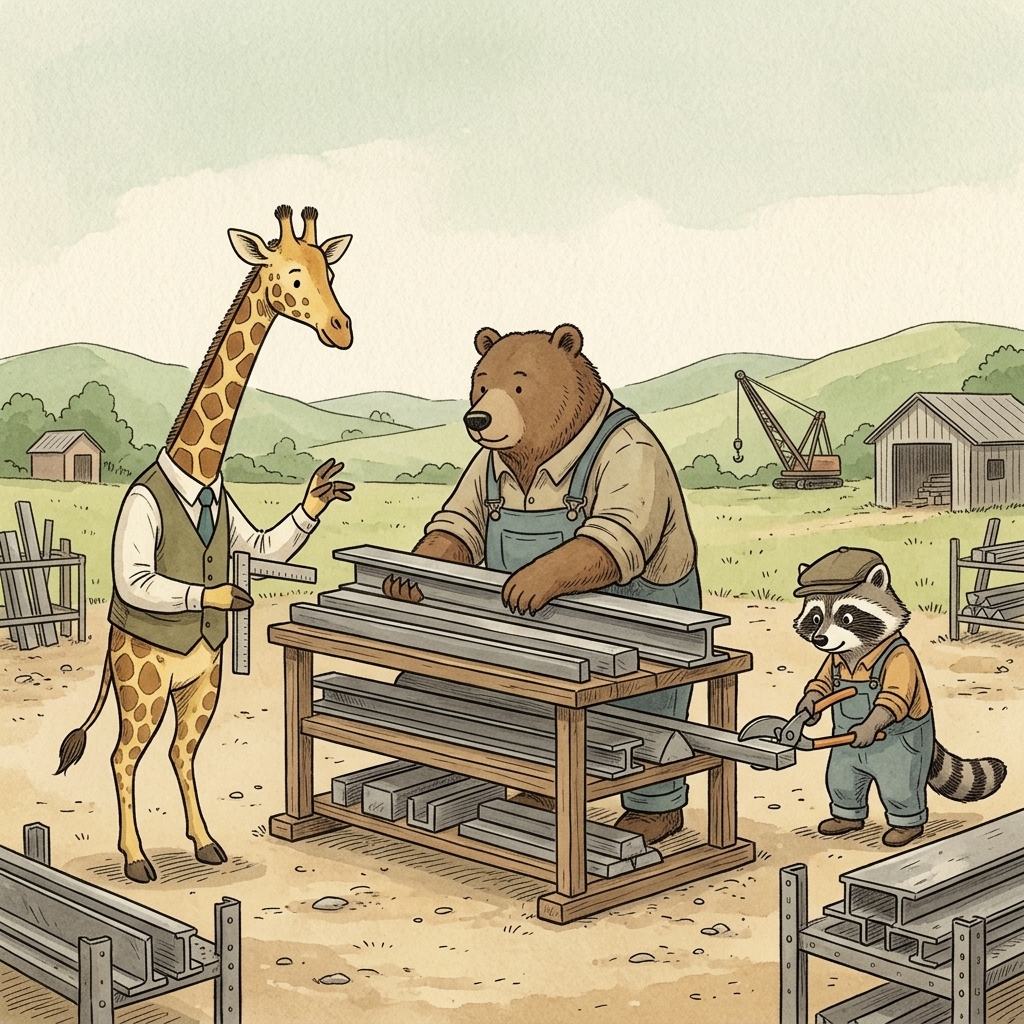
This is a metals distribution business built on a deliberate contrarian premise: compete on service and depth, not on price. Operating for nearly four decades in the Southern California market, the business runs a hybrid model that is roughly half inventory-based and half brokered. On-floor inventory is dedicated to long-standing key accounts, while the broker side sources carbon steel, stainless, and aluminum on demand, letting the company quote complete mixed-material lists that pure stocking distributors cannot fill. The fabrication division was retired in 2014; this is distribution and processing only, with no licensing required of a buyer.
The owner reports that the top five customers represent roughly 77% of revenue, with most of those relationships running 15 to 30 years and annual churn around 5%. Critically, the account relationships are held by the company's salespeople rather than by the owner, so they transfer with the team. That team, about 10 employees, has had zero turnover and no new hires in five years. The owner is in the office one day a week, with day-to-day management handled by staff.
Revenue has grown each of the past three years, from $3.9M in 2023 to $4.8M in 2025 and $5.2M on a trailing-twelve-month basis, with adjusted cash flow growing from roughly $234K to $564K over the same stretch. 2026 is tracking ahead of 2025, profitable in seven of the first nine months. A full add-back schedule has been prepared, and one-time items, including a legal settlement, have been excluded from the adjusted figures rather than counted as earnings.
The growth story is unusually concrete because the owner has deliberately run the company in preservation mode for several years: the current footprint can absorb roughly 30% more volume without new trucks or major capital expenditure, there has been no dedicated sales hire or business development push, and no digital or AI-assisted outreach has ever been deployed. The levers are identified, inexpensive, and unpulled.
The owner founded the business in 1988 and is ready to hand it to someone who can carry it forward; his stated priority is a buyer who will value and retain the team. He is willing to stay on as a consultant for up to two years, is open to seller financing, and is not tied to the current location. The standout: a half-brokered, half-inventory model with above-norm margins and below-norm overhead, stable and growing on one day a week of owner attention.
What exactly does this business do?
The company is a 38-year-old steel service and distribution business in Southern California, supplying carbon steel, stainless, and aluminum to industrial customers. It runs a hybrid model that is roughly half inventory-based and half broker/buyout-based: on-floor inventory is dedicated to key accounts, while the broker side sources material on demand. That combination lets the company quote mixed-material lists that pure stocking distributors can't, and it competes on service and reliability rather than on being the lowest-cost supplier. The business is distribution and processing only, so no specialized licensing is required of a buyer.
Who are the customers?
The company sells only to end users, never to other brokers or distributors. Customers are mainly manufacturers and contractors across industrial, construction, automotive, commercial, fabrication, furniture, and underground infrastructure work, primarily in the greater Los Angeles area. The ideal customer is less price-sensitive and values same-day delivery, hard-to-find material, tight tolerances, or value-added services like cutting, forming, or plating. Customer names are shared in due diligence.
How concentrated is the customer base?
The top five accounts represented 65.5% of sales in 2022, 63.3% in 2023, 68.9% in 2024, 66.5% in 2025, and 76.2% so far in 2026. The 2026 increase reflects a new key account added during this year's beam shortage. The largest single customer is typically 20 to 25% of sales. Most key accounts have been customers for 10 to 30 years, the top two for more than 20, and annual churn runs around 5%. The account relationships are managed day to day by the company's salespeople, and the dedicated on-floor inventory for key accounts further cements them. Average gross margin on the top accounts is above 35%.
Are there contracts with the key customers?
No. Like most of the industry, customers buy on purchase orders rather than long-term contracts. In practice the key accounts commit to taking the material the company brings in and stocks for them, and the top accounts have been buying for more than 20 years. The relationships are managed by the sales team and have held steady through market cycles.
How does revenue split between inventory sales and broker sales, and how do margins compare?
The owner estimates the business is roughly 50/50 between inventory and broker sales. The split is not broken out separately in the accounting system or financials. Broker sales carry the better margin. Inventory is closer to a loss leader: it is bought for specific customers, turns roughly every 90 days, and gives the company credibility and same-day capability with its key accounts, which in turn drives the higher-margin broker business.
What does the inventory consist of, and what is it worth?
The inventory is a broad, working stock of metals: angles, channels, pipe, tubing, sheet, coil, plate, bars, and wide-flange beams, spanning structural and non-structural product in carbon steel, stainless steel, aluminum, and alloys. The owner reports inventory value of approximately $537,000 as of September 30, 2026, and approximately $589,000 in mid-October, and that movement is the point: this is live, turning inventory that changes daily as material is bought, processed, and sold, not a static pile. Roughly 5% is estimated to be obsolete or scrap, which the owner discloses up front. A full item-level inventory report runs many pages and can be produced for serious buyers in diligence, with the understanding that the exact figure will differ day to day.
What is the financial trajectory?
The business had strong years in 2021 and 2022, with revenue of roughly $6M in 2022, before resetting in 2023. Since then revenue has grown three years running: $3.9M in 2023, $4.4M in 2024, $4.8M in 2025, and $5.2M on a trailing-twelve-month basis through August 2026, with adjusted cash flow growing from roughly $234K to $317K to $493K to $564K over the same periods. 2026 is tracking ahead of 2025, with the business profitable in seven of the first nine months of the year. A full add-back schedule is available in the data room.
Is tonnage or volume data available?
The company does not track tons. Because it sells a mix of carbon steel, stainless, aluminum, and wire, weight is not a meaningful comparison across products, so the business manages to profit instead. The owner reports that both pricing and volume have increased in recent years, so revenue growth is not purely a function of higher steel prices.
Are there any one-time items in the financials?
Yes, and it has been handled conservatively. The company received a settlement from T-Mobile reimbursing roughly seven years of electricity that a cell tower had drawn from the company's meter. Because it is a one-time recovery, the settlement has been excluded from adjusted cash flow rather than counted as earnings, so the adjusted figures understate rather than inflate the business's run-rate performance. The full add-back schedule is available in the data room.
What are the add-backs?
Add-backs are owner-related expenses that would not continue under a new owner, including an owner vehicle, owner entertainment, book promotion and related advertising, and personal expenses run through company credit cards. The owner has supporting documentation for each item, and the full add-back schedule is available in the data room.
Who runs sales, and will they stay after a sale?
The company has thr