5 Great SMB Acquisition Opportunities for 2026
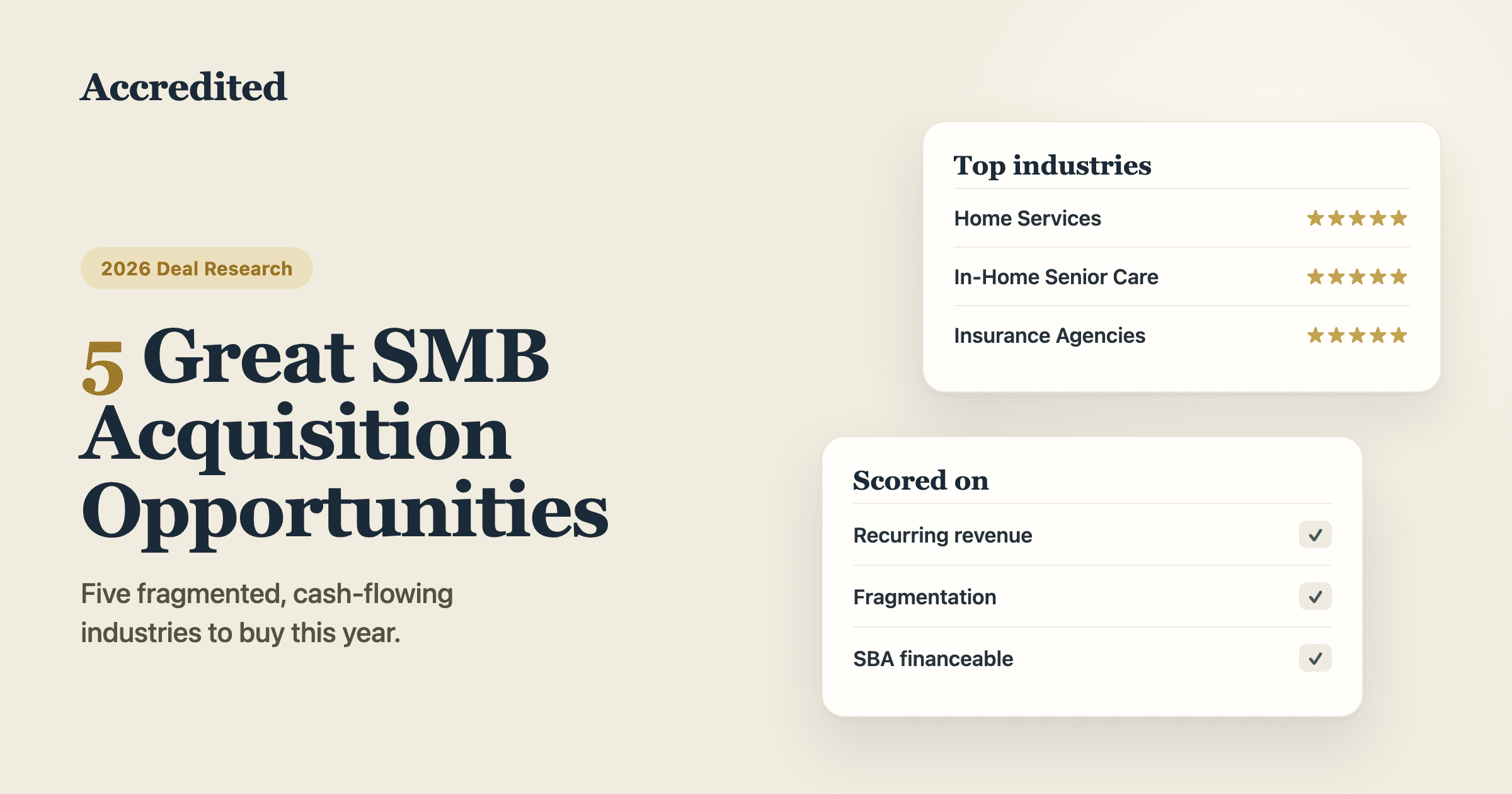
TL;DR: The best small businesses to buy in 2026 are essential, fragmented, cash-flowing, and financeable with an SBA loan. Our top five are home services (HVAC, plumbing, and electrical), in-home senior care, commercial landscaping, independent insurance agencies, and property management companies. Each one rides a wave of retiring baby-boomer owners, sells at a reasonable multiple, and produces recurring revenue a buyer can underwrite and finance. Below we score all five and show what a great target looks like in each.
2026 is a buyer's market for patient, prepared operators
The single largest transfer of small business ownership in American history is underway. Roughly 10,000 baby boomers reach retirement age every day, and by 2030 the entire generation will have passed 65. Boomers still own roughly 12 million privately held companies, yet most have no documented succession plan. In one 2025 survey, 48% of business owners said they want to exit within three years.
The scale is hard to overstate. Analysts estimate roughly $10 trillion in business assets will change hands over the next two decades, and McKinsey projects about 6 million SMB ownership transitions by 2035, with more than a million firms viable for sale. For a prepared buyer, that is not a statistic. It is deal flow.
The market on the other side of that wave has matured. BizBuySell reported that 2025 stabilized, with the median sale price reaching $350,000 and both cash flow and revenue up about 3% for the year. Early 2026 looks similar: steady volume, and a clear split between selective buyers competing hard for strong, cash-flowing businesses and softening interest in flat or declining ones. Nearly two thirds of brokers expect deal volume to rise over the coming six months. Translation: quality gets bid up, and mediocre gets ignored.
How we chose: the Accredited filter, applied to whole industries
At Accredited, every listing our team writes up has to clear three thresholds: seller's discretionary earnings of at least $500,000, ten or more years in business, and verified financials. For this report we applied the same discipline one level up, to the industries themselves. We were not looking for the fastest-growing sectors or the trendiest ones. We were looking for durable, boring, essential businesses where a diligent operator can buy well, finance cleanly, and sleep at night.
We scored each candidate industry across six dimensions:
- Demand durability. Is the underlying need essential and resistant to recessions and to being automated away?
- Fragmentation and roll-up runway. Are there thousands of independent operators and no dominant national brand, leaving room to grow by acquisition?
- Recurring revenue. How much of next year's revenue is already on the books through contracts, renewals, or repeat need?
- Margins and cash flow. Does the work convert into real, bankable owner earnings?
- Financeability. Does a typical deal fit cleanly inside an SBA 7(a) structure?
- Deal supply. Is the ownership base aging, creating a steady stream of sellers?
The five industries below scored highest on the blend. None of them is a secret. That is the point: their attractiveness is structural, not speculative.
The five best small businesses to buy in 2026, side by side
A quick map before the deep dives. Ratings are on a five-star scale, and the "typical multiple" is the median seller's discretionary earnings (SDE) multiple from recent BizBuySell sale data in our valuation database. These are the numbers a typical small operator actually sells for. Larger, professionalized businesses are valued on EBITDA and command higher multiples, and private-equity roll-up platforms higher still.
| Industry | Market size or retention | Typical multiple (SDE) | Rating |
|---|---|---|---|
| Home services (HVAC, plumbing, electrical) | $350B+ U.S. HVAC market alone | 2.5x to 3x SDE | ★★★★★ |
| In-home senior care (non-medical and home health) | ~$415B U.S. senior care category | 2.8x to 3.2x SDE | ★★★★★ |
| Commercial landscaping (grounds and snow) | $196B U.S. landscaping market (2026) | ~2.5x SDE | ★★★★☆ |
| Independent insurance agencies (property and casualty) | Renewal-driven commission books | ~2.7x SDE (~1.5x revenue) | ★★★★★ |
| Property management (residential, HOA, and commercial) | $140B U.S. industry; $100B+ residential | ~2.7x SDE (~0.9x revenue) | ★★★★★ |
1. Home services (HVAC, plumbing, and electrical)
The consolidation magnet.
If there is a single category institutional money has fallen in love with, it is the essential home trades. Private equity has poured more than $50 billion into residential HVAC, plumbing, and electrical roll-ups since 2018, and the pace is accelerating. Add-on acquisition activity in HVAC rose roughly 88% year over year through mid-2025, and financial buyers now account for about half of all HVAC service transactions, up from roughly a third a year earlier. In early 2026, Blackstone agreed to pay about $2.5 billion for one platform at nearly 18.5 times EBITDA, and Apollo committed roughly $2 billion to another.
Why home services is attractive in 2026
Start with demand you cannot wish away. When a furnace dies in January or a pipe bursts at 2 a.m., the homeowner calls someone that day and does not haggle. The U.S. HVAC market alone exceeds $350 billion and is growing at a mid-single-digit rate. The work is essential, largely recession resistant, and nearly impossible to offshore or automate.
Then there is the structure. The industry is spectacularly fragmented, with hundreds of thousands of independent contractors and no dominant national brand. The average plumbing owner is 58 or older with no succession plan. That combination, deep fragmentation plus an aging ownership base, is exactly why consolidators expect five to eight more years of active deal flow. As a buyer, you are competing for the same tailwind the big platforms are, one town at a time. You can browse vetted home services businesses for sale on our platform.
What a great home-services target looks like
Green flags to look for:
- A growing base of recurring service agreements (maintenance memberships), which smooth revenue and lift resale value.
- A licensed, tenured technician team that does not depend on the owner holding the master license.
- A healthy mix of service and replacement work rather than reliance on new-construction projects, which are cyclical.
- Reviews, brand, and dispatch reputation that generate inbound calls without heavy ad spend.
Watch-outs: The flip side of institutional interest is price. In hot metros, sellers have heard the roll-up pitch and expect roll-up multiples, so discipline matters. Technician recruiting and retention is the operational bottleneck in almost every market. And beware businesses where the owner is the top salesperson, top technician, and the relationship every large customer actually trusts. That is a person you cannot buy, only rent through a transition.
Accredited attractiveness rating
| Dimension | Rating |
|---|---|
| Demand durability | ★★★★★ |
| Fragmentation and roll-up runway | ★★★★★ |
| Recurring revenue | ★★★★☆ |
| Margins and cash flow | ★★★★☆ |
| Financeability (SBA fit) | ★★★★★ |
| Deal supply (owner succession) | ★★★★★ |
2. In-home senior care (non-medical and home health)
The demographic certainty.
Few investment theses are as demographically certain as this one. The U.S. population over 65 is projected to grow from about 62 million in 2025 to 80 million by 2040, an increase of 18 million people. The oldest and most care-intensive group, those over 85, is expected to nearly double from 6.7 million to around 12 million in the same period. Meanwhile 77% of adults over 50 say they want to age in place in their own homes, a figure that climbs above 80% once people pass 65.
Why senior care is attractive in 2026
The math is simple and relentless: more older people, living longer, who overwhelmingly want care delivered at home. The U.S. senior care category sits at roughly $415 billion and the elderly care market is compounding at close to 9% a year, with home-focused segments growing faster still. This is demand that does not care about the business cycle, interest rates, or the news.
The non-medical in-home care model is also genuinely recurring. Agencies bill families or insurers an hourly rate, commonly $30 to $45 in most markets, for care that continues week after week. Gross margins typically run 35% to 45%, settling into a 12% to 20% operating margin after the cost of caregivers and coordination. A well-run agency with a stable client roster and a reliable caregiver bench is, in effect, a subscription business wearing scrubs. See current senior care businesses for sale.
What a great senior-care target looks like
Green flags to look for:
- A diversified referral network (hospitals, discharge planners, senior communities) rather than dependence on one or two sources.
- Low caregiver turnover relative to the market, and a real recruiting pipeline.
- A clean compliance and licensing history, with documentation that survives an audit.
- A mix of private-pay and insurance clients, with private-pay improving margin quality.
Watch-outs: This is a people business first and a care business second. Caregiver recruiting and retention is the whole game, and labor is tight. Margins are thinner than in the trades, so scale and scheduling efficiency matter. Reimbursement-heavy models add regulatory and payment-timing risk, which is why many buyers favor private-pay agencies. Do the diligence on client concentration and on whether the owner personally holds the key referral relationships.
Accredited attractiveness rating
| Dimension | Rating |
|---|---|
| Demand durability | ★★★★★ |
| Fragmentation and roll-up runway | ★★★★☆ |
| Recurring revenue | ★★★★★ |
| Margins and cash flow | ★★★☆☆ |
| Financeability (SBA fit) | ★★★★☆ |
| Deal supply (owner succession) | ★★★★☆ |
3. Commercial landscaping (grounds maintenance and snow)
The recurring-contract play.
Commercial landscaping is the quiet compounder of the essential-services world. The U.S. landscaping market is on track to grow from about $186 billion in 2025 to $196 billion in 2026, expanding at roughly 5.5% a year. There are more than 600,000 landscaping businesses in the country, and the vast majority do under $5 million in revenue. The top five players hold only a sliver of the market. For a buyer, that is a wide-open, highly fragmented field.
Why commercial landscaping is attractive in 2026
The magic word is maintenance. Ongoing grounds maintenance accounts for the largest slice of industry revenue, around 44%, and it behaves like a subscription. Commercial properties, HOAs, and municipalities sign seasonal or annual contracts that renew with little friction, which is precisely why private equity has moved in. In recent sale data, typical operators trade around 2.5x SDE, while professionalized platforms with strong recurring commercial contracts command higher EBITDA multiples. In snow markets, winter services layer a second contracted revenue stream onto the same crews and equipment.
Unlike one-off installation and design work, which is lumpy and economically sensitive, a commercial maintenance book is predictable cash flow you can underwrite and finance. And the ownership base skews older, so the supply of sellers is steady and growing. Browse landscaping businesses for sale on our platform.
What a great landscaping target looks like
Green flags to look for:
- A high share of revenue under recurring commercial maintenance contracts rather than one-time installs.
- Multi-year customer relationships with strong renewal rates and diversified accounts.
- Owned equipment and a stable crew, with route density that keeps drive time low.
- Snow or other seasonal services that use the same assets in the off months.
Watch-outs: Labor and seasonality are the perennial challenges, and many operators lean on seasonal and H-2B labor, which adds complexity. Design-build heavy shops carry more cyclicality than pure maintenance operators. Margins can be thin if routes are inefficient or equipment is aged and due for replacement. Concentration in a single large contract, a municipality or a major property manager, is a real risk to underwrite carefully.
Accredited attractiveness rating
| Dimension | Rating |
|---|---|
| Demand durability | ★★★★☆ |
| Fragmentation and roll-up runway | ★★★★★ |
| Recurring revenue | ★★★★☆ |
| Margins and cash flow | ★★★☆☆ |
| Financeability (SBA fit) | ★★★★★ |
| Deal supply (owner succession) | ★★★★★ |
4. Independent insurance agencies (property and casualty)
The annuity in disguise.
An independent property and casualty insurance agency is, at heart, an annuity. Customers renew their auto, home, and commercial policies year after year, and the agency collects a commission each time. The best books see 85% or more of commission revenue renew annually, with client retention above 92%. In recent sale data, agencies trade around 2.7x SDE, or roughly 1.5x revenue, richer than most Main Street businesses, and larger, professionalized books command higher EBITDA multiples still.
Why insurance agencies are attractive in 2026
Insurance is legally and practically mandatory. You cannot drive a financed car, hold a mortgage, or run most businesses without it, which makes the underlying demand about as durable as it gets. The revenue is contractual and recurring, the margins are high because the agency carries none of the underwriting risk, and the model is asset-light. A book of business, in effect, pays you to hold it.
The opportunity for individual buyers comes from the ownership demographics. Many agency principals are in their sixties with no producer pipeline and no successor, and the value of their personal client relationships quietly erodes every year they wait. That succession gap, combined with retention-driven cash flow, makes a well-run agency one of the most financeable and defensible small businesses you can acquire.
What a great insurance-agency target looks like
Green flags to look for:
- High renewal retention (over 90%) and a book weighted toward renewal commissions rather than one-time placements.
- Diversified carriers and clients, with no single account representing an outsized share of revenue.
- Licensed service staff who own the day-to-day client relationships, so the book does not walk out with the seller.
- A clean loss ratio and carrier standing that keeps contingent commissions and appointments intact.
Watch-outs: The core risk is relationship transfer. If the retiring owner is personally the agency in the eyes of clients and carriers, retention can slip after closing, so structure the transition and earn-out accordingly. Captive arrangements (where the agency writes for a single carrier) limit flexibility compared with truly independent books. And rate cycles and carrier appetite can pressure commissions, so understand the mix before you sign.
Accredited attractiveness rating
| Dimension | Rating |
|---|---|
| Demand durability | ★★★★★ |
| Fragmentation and roll-up runway | ★★★★☆ |
| Recurring revenue | ★★★★★ |
| Margins and cash flow | ★★★★★ |
| Financeability (SBA fit) | ★★★★☆ |
| Deal supply (owner succession) | ★★★★☆ |
5. Property management (residential, HOA, and commercial)
The recurring-fee compounder.
Property management is one of the most quietly durable recurring-revenue businesses on Main Street, and it is consolidating fast. The U.S. property management industry generates roughly $140 billion in annual revenue, with residential management alone accounting for more than $100 billion of it. The field is remarkably fragmented, with more than 102,000 private establishments and no national brand controlling more than a sliver of the market. Private equity has taken notice: the sector is in the middle of the most active consolidation wave in its history, with platforms rolling up regional operators across single-family, multifamily, HOA, commercial, and short-term rental books.
Why property management is attractive in 2026
The appeal starts with the revenue model. A property manager typically earns a monthly fee of 8% to 12% of rent collected, billed month after month under contracts that renew automatically and are rarely canceled. Owners seldom switch managers casually, so the book is sticky and the cash flow is predictable. Just as important, the model is asset-light: you manage other people's real estate rather than owning it, so you capture recurring fee income without carrying the property itself. Rental housing is a permanent need, which makes the underlying demand about as durable as it gets.
That combination is exactly what buyers pay up for. In recent sale data, property management businesses trade around 2.7x SDE, or roughly 0.9x revenue, and HOA, community-association, and multifamily platforms with recurring fee streams and software lock-in command higher EBITDA multiples. Because the sector is so fragmented and full of small owner-operators, the supply of sellers is deep, and consolidators routinely pay premium multiples for well-run first add-ons, sometimes with rollover equity that gives the seller a second bite at the platform's eventual exit. For a deeper look at why this category screens so well, see our property management acquisition thesis.
What a great property-management target looks like
Green flags to look for:
- A high share of recurring monthly management-fee revenue under long-term contracts with automatic renewals, rather than one-time leasing or project fees.
- A stable, growing portfolio of doors under management with low owner churn and diversified clients.
- A modern software stack and documented processes, so the business does not live in the owner's head.
- Current state licensing and trust-accounting compliance, with clean books that survive diligence.
Watch-outs: Margins depend on operational efficiency, and too many doors per coordinator, or a heavy maintenance-coordination burden, can erode profitability. Trust-accounting and licensing rules vary by state and must be clean before you close. Watch for concentration in a single large owner or institutional client, and for books padded with volatile one-time fees rather than durable recurring management income. As always, if the owner personally holds the key owner relationships, plan a real transition.
Accredited attractiveness rating
| Dimension | Rating |
|---|---|
| Demand durability | ★★★★★ |
| Fragmentation and roll-up runway | ★★★★★ |
| Recurring revenue | ★★★★★ |
| Margins and cash flow | ★★★★☆ |
| Financeability (SBA fit) | ★★★★☆ |
| Deal supply (owner succession) | ★★★★★ |
How to finance an SMB acquisition in 2026
Every industry above shares a quiet advantage: it fits the SBA 7(a) loan, the primary financing tool for acquisitions under $5 million. The program now lends up to $5 million (recently raised from $3.75 million) and typically finances around 90% of the deal, meaning a buyer can close with roughly 10% down, part of which can come from a seller note held on standby rather than all from your own cash.
Rates in 2026 generally run in the 10% to 11% range (Prime plus a lender spread), with amortization around ten years for a business-only purchase and up to 25 years when real estate is included. Lenders will want to see a buyer with a solid credit profile, relevant management or industry experience, and a target showing at least two years of consistent positive cash flow with a debt-service coverage ratio comfortably above 1.25. The essential, recurring-revenue businesses in this report tend to clear that bar cleanly.
For the full acquisition process, from qualifying to closing, see our guide on how to buy a small business, and when you are ready to price a target, start with the five valuation methods every buyer should know.
Run your own deals through the same lens
These five industries scored highest because their attractiveness is structural: essential demand, deep fragmentation, recurring revenue, financeable cash flow, and a wave of retiring owners. But the framework matters more than the list. Score any industry or specific target across the same six dimensions, and you can compare opportunities on the merits rather than the pitch.
The best businesses rarely announce themselves. They are found by buyers who know what good looks like, move deliberately, and have their financing ready before the right deal crosses the desk.
The best businesses, for the best buyers. Our team scans hundreds of private businesses for sale every day, filters for the top 1%, and writes up one fully analyzed deal each weekday, exclusive to accredited investors. Browse today's deals or create a free account to get one vetted deal a day.
Frequently asked questions
What are the best small businesses to buy in 2026?
The best small businesses to buy in 2026 are essential, fragmented, recurring-revenue businesses with a large base of retiring owners. Our top five are home services (HVAC, plumbing, and electrical), in-home senior care, commercial landscaping, independent insurance agencies, and property management companies. Each combines durable demand with cash flow that a buyer can finance through an SBA 7(a) loan.
What multiple do these small businesses sell for?
Based on recent BizBuySell sale data in our valuation database, most of these businesses trade around 2.5x to 3.2x seller's discretionary earnings (SDE). Home services (HVAC, plumbing, electrical) run about 2.5x to 3x SDE, in-home senior care about 2.8x to 3.2x SDE, commercial landscaping about 2.5x SDE, independent insurance agencies about 2.7x SDE (roughly 1.5x revenue), and property management about 2.7x SDE (roughly 0.9x revenue). Larger, professionalized businesses are valued on EBITDA and command higher multiples, and private-equity roll-up platforms higher still, but these SDE ranges reflect what a typical small operator sells for.
How do you finance a small business acquisition?
Most acquisitions under $5 million are financed with an SBA 7(a) loan, which now lends up to $5 million and typically covers about 90% of the purchase price. A buyer can often close with roughly 10% down, part of which may come from a seller note. In 2026, rates generally run 10% to 11%, with terms up to 10 years for a business-only purchase and up to 25 years when real estate is included. Lenders look for relevant experience, solid credit, and a target with at least two years of consistent cash flow.
Why are so many small businesses for sale right now?
Roughly 10,000 baby boomers reach retirement age every day, and boomers still own about 12 million privately held companies, most without a succession plan. Analysts expect roughly $10 trillion in business assets to change hands over the next two decades. That aging ownership base is creating a large, steady supply of profitable businesses coming to market.
What makes a business a good acquisition target?
A strong target has durable, essential demand, a high share of recurring or contracted revenue, healthy and transferable cash flow, low customer concentration, and relationships that do not walk out the door with the seller. It should also fit cleanly inside SBA financing, which usually means at least two years of consistent positive cash flow and a debt-service coverage ratio above 1.25.
Sources and further reading
- McKinsey and Company and industry analyses on the "silver tsunami" of SMB ownership transitions and the projected $10T asset transfer.
- BizBuySell Insight Report, 2025 full-year and Q1 2026 data on transaction volume, median sale price, and buyer sentiment.
- U.S. Small Business Administration, 7(a) loan program terms; Bay Street Lending and NerdWallet SBA rate summaries (2026).
- Kroll and PKF O'Connor Davies HVAC M&A updates; Capstone Partners add-on activity data; Profitability Partners and CT Acquisitions home-services private-equity trackers (2025 to 2026).
- Fortune Business Insights, Grand View Research, Precedence Research, and Coherent Market Insights on elderly and home-healthcare market size and growth; AARP Home and Community Preferences Survey; U.S. Census Bureau 2024 National Population Projections.
- Mordor Intelligence and IBISWorld U.S. landscaping market data; Main Street Wealth and CT Acquisitions landscaping M&A multiples (2026).
- IA Valuations, QuoteSweep, and CT Acquisitions insurance agency valuation and M&A multiple reports (2026).
- IBISWorld and Mordor Intelligence U.S. property management market data; iPropertyManagement industry statistics; CT Acquisitions and Parkland Capital Partners property management valuation and M&A multiple reports (2026).
Accredited is a media and research platform. We are not a broker-dealer, registered investment adviser, or tax or legal professional. Market figures are drawn from third-party sources believed reliable but not independently audited, and represent typical ranges rather than guarantees. Verify all information independently before transacting.